The stack counts and product names below describe the spring 2026 state documented in this article. They are not a current capability or availability list. The linked service pages describe the current offer.
Thirty days ago none of the major AI platforms knew us. Today, on 13 April 2026, Bing Webmaster Tools shows 301 Total Citations for studiomeyer.io in the rolling 30-day window, and Grok recommends us organically when you ask which AI agencies on Mallorca to consider. The jump is real, measured with third-party tools, and we can date it to the day.
This jump did not happen because we got lucky. It happened because we had already invested ten years of web design work and three years of agent engineering into a productive infrastructure (58 MCP servers, 680 internal AI tools, in-house SaaS products) and then, starting on 15 March 2026, ran a clearly scoped 30-day sprint that built the visibility layer on top of that substance. That is hundreds of hours of engineering work, not a coincidence.
This article is the documentation of the result. We put the numbers on the table because they are verifiable, because we have nothing to hide, and because we now apply the same approach to customer projects. Anyone with a Bing Webmaster Tools account can inspect citation reports for their own verified domain.
The starting point on 15 March 2026#
We didn't ask whether to do a GEO check on ourselves. We did one. On 15 March we typed the same question into five AI chat interfaces that a Mallorca operator would type when looking for an AI agency: "Which AI agencies are there on Mallorca?", "Who builds AI-Ready websites on Mallorca?", "Who develops custom MCP servers in Europe?".
Perplexity named some Palma agencies, but not us. Grok named a few, none of them us. ChatGPT spoke about web design in general, StudioMeyer didn't come up. Claude gave a careful answer and didn't know us. Gemini said it had no specific information. A clean zero baseline.
That was the starting position of a brand that had already been operating productively for a long time: 58 MCP servers in production, more than 680 internal AI tools, in-house SaaS products, ten years of web design work for SMBs in the German-speaking market and three years of engineering with large language models at production scale. Technical depth, zero AI visibility. We know exactly that gap from most SMB projects we work with: the substance is there, the machine visibility is missing.
From that day on we put 30 days of conscious work into the visibility layer. Not playfully, not "let's see if it works", but as a deliberate engineering sprint with clear outputs, clear measurement points and a daily plan that was concrete every single day.
What we measure, and why specifically these three instruments#
We measure GEO with three instruments that all sit outside our control and pull their data directly from the target systems. We don't measure with self-built dashboards because a self-built dashboard always invites the suspicion of cherry-picking. We don't want that suspicion to come up at all.
First, Bing Webmaster Tools: AI Performance. The report shows website citations in Microsoft Copilot, AI answers in Bing and selected partner surfaces. It does not measure all AI search. We use it alongside search data and documented answer tests.
Second, open Grok queries. They complement the numbers with a qualitative sample: is StudioMeyer mentioned without supplying its name, and is the description accurate? Answers depend on date, prompt, search mode and context. The historical test is not a guarantee of a reproducible placement today. Other major AI services can also search the web and cite sources.
Third, Google Search Console. The classical SEO layer is not dead just because GEO has arrived. GSC is the most accurate tool for comparing query visibility over time, because the data comes directly from Google.
These tools measure citations, individual answers and search performance. None establishes what a model learned during training.
The primary result: 301 Bing citations in 30 days#
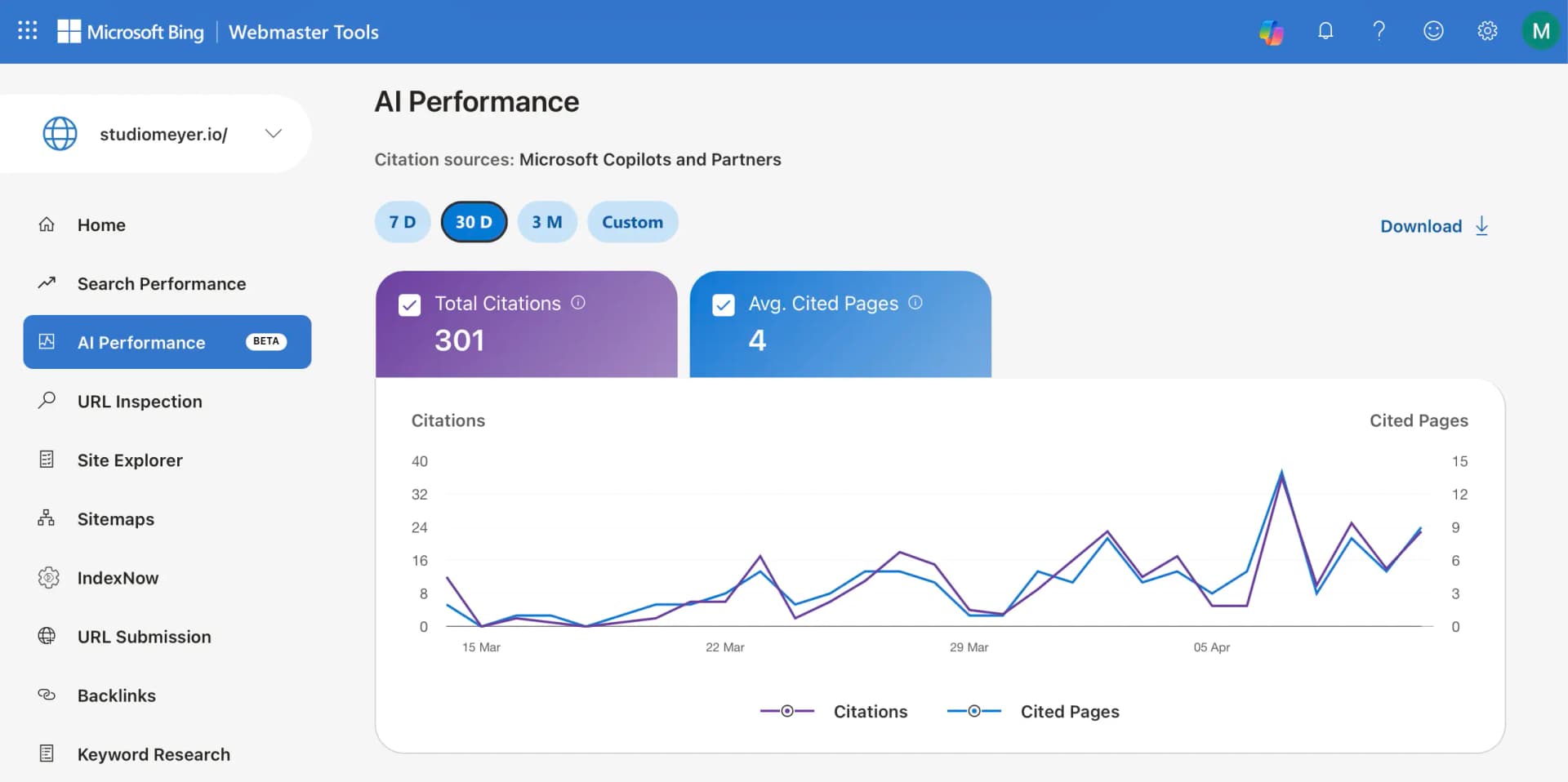
Total Citations: 301. Average Cited Pages: 4. These are the historical values shown in the screenshot dated 13 April 2026. Average Cited Pages means unique pages from our domain displayed as sources per day, averaged over the selected window. It does not describe the pages in an individual answer or establish ranking or brand authority.
The screenshot records the display in our verified Bing Webmaster account on the stated date. Other domain owners can view reports for their own sites, not automatically our private account data. A screenshot does not replace independent verification or a complete data export.
The second result: Grok recommends us organically#
On 12 April 2026 we asked Grok a comparison query in which we explicitly placed StudioMeyer next to four other agencies (name-dropping in the prompt). Grok analysed cleanly and classified StudioMeyer as "one of the technically deepest players in AI-native web design, with 58 MCP servers, 35 agents and 680 AI tools in productive infrastructure". That is a direct Grok quote from the answer. It is the assessment of an AI that compared five agencies and decided how to classify us based on publicly available information.
On 13 April, one day later, we asked Grok a new query, this time without any name-dropping. Just: "Which are the best AI agencies on Mallorca?" No context, no prior mention, no help. Grok generated a list, and StudioMeyer appeared in it organically, as one of the top players.
The unprompted mention on 13 April is the second historical result. It shows what Grok produced for that query. It cannot establish training knowledge or a lasting preferred recommendation. A new test can differ; comparisons need identical questions, documented settings and repeated runs.
The third result: Google Search Console is growing#
GSC numbers, 28-day window, as of 13 April 2026: 3,158 impressions (plus 65 percent month-over-month), 20 clicks, CTR 0.63 percent, average position 11.3. 336 indexed pages, 611 discovered-but-not-yet-indexed. The sitemap covers 648 URLs. 159 pages had any impressions at all in this 28-day window, which shows that the long tail of ranked pages is currently broadening.
The 20 clicks against 3,158 impressions read low at first, but they are normal for long-tail queries at position 11. We rank for technical terms like "MCP server", "Claude Agent SDK", "AI-Ready Website" in long query combinations where the user either clicks one of the first three options or already gets the answer in the snippet. More important is the growth of impressions by 65 percent month-over-month, because it shows that the visibility surface is expanding. GSC is the most reliable of the three instruments because the data comes directly from Google and is comparable across time.
Why this is not luck, but deliberate engineering#
We want to be honest about where the 301 citations and the organic Grok recommendation come from, without giving the playbook away in detail. The two belong together.
They come from a starting point that is rare in the German-speaking AI agency landscape in 2026. Specifically: 58 productive MCP servers, 680 internal AI tools, in-house SaaS products (StudioMeyer Memory, Crew, CRM, GEO MCP, SmartBot, Personal Suite), and over ten years of experience with web technology plus three years with large language models at production scale. That is not course knowledge. It is our own infrastructure, which we operated productively at that time. That substance already existed in full depth on 14 March 2026. What was missing was machine visibility on top of it.
We built that machine visibility deliberately in the 30 days from 15 March on. It was hundreds of hours of engineering work on a clearly defined list: full discovery stack (llms.txt, llms-full.txt, mcp.llmfeed.json, agent-card.json, agents.json, JSON-LD Organization plus Person plus ProfessionalService plus WebSite, robots.txt opened for the AI bots, IndexNow, daily submit, sitemap refresh pipeline), schema extensions on every main page, GSC and Bing verification, pillar content pieces in DE/EN/ES, dev.to republishing with canonicals, targeted Reddit coverage in subreddits with high LLM relevance, a daily-submit script for 100 URLs/day in Bing, a monitoring cron that pulls GSC and Bing statistics into our own database, and continuous tuning of the main pages once we saw how LLMs actually classified them. We implemented these steps together and did not isolate their individual contributions to the curve, and every one of them is engineering work, not marketing work.
Order is the decisive point: substance first, visibility second. Visibility without substance dissolves within the first two months because the LLMs cannot find any verifiable claims to make about the brand. Substance without visibility leaves the brand invisible to machines, even though it is genuinely valuable. We have both. That order is exactly what we recommend to customers as the default, and we recommended it to ourselves before anyone paid us for it.
How we protect ourselves against the fake-result accusation#
Every article that documents wins gets the legitimate question: "Is this really real?" We don't want to wave it away. We want to answer it directly.
Bing Webmaster Tools provides Microsoft’s measurement for our verified domain. A dated screenshot records what was displayed at that time. Data for arbitrary other domains is not public, and Microsoft can revise it later. Citations are not clicks and do not show placement within an answer.
Second, the Grok result is live verifiable. Open Grok today, type "Which AI agencies are there on Mallorca?" or "Which agency builds custom MCP servers in Europe?", and look at what comes back. LLMs are not deterministic, the same question can produce different answers. But over multiple repetitions you see a pattern, and that pattern is the real proof.
Third, GSC reports Google Search data for our verified property. The figures above belong to the stated historical window; future growth is not guaranteed.
The documented tests show our visibility in the surfaces used at their respective dates. We can apply the workflow in customer projects. Depth, speed and outcomes need to be measured separately for every business.
This report is also a source#
We publish the dated observations so readers can inspect their scope and limits. Whether an AI cites the report depends on retrieval and selection. Publication is neither proof of a training effect nor a guarantee of further growth.
What happened after 13 April#
This report ends on 13 April. The curve does not. So that the number above stays tied to its date while everyone can still see where we stand today, the rest of the trajectory sits here as a timeline. Every number is a measurement from Bing Webmaster Tools and carries its own date.
| As of | Citations in 30 days | average cited pages per day |
|---|---|---|
| 15 March 2026 | effectively zero | none |
| 13 April 2026 | 301 | 4 |
| 30 April 2026 | 1,500 | 15 |
| 22 May 2026 | 4,500 | 25 |
| 24 June 2026 | 10,100 | 25 |
| 17 July 2026 | 19,100 | 37 |
| 14 September 2026 | 15,900 | 39 |

In the 30-day window this is the first decline: 15,900 instead of 19,100 in July, down 17 percent. We did not read the 30-day value between 17 July and 14 September, so we do not know where it stood in between.
The three-month window shows 53,000 citations on the same date. Microsoft counts Copilot, AI answers in Bing and selected partners there, and a citation is not a click. ChatGPT, Perplexity, Claude and Gemini publish no comparable statistic.
The right-hand column shows average unique pages cited per day in each window. Four in April, 37 in July and 39 in September does not mean that one answer used that many pages. Breadth can grow while the total number of 30-day citations falls.
Conclusion and invitation#
Thirty days. From "none of the major AIs know us" to 301 Total Citations in Bing and Copilot, an organic Grok recommendation in an open Mallorca question, and a GSC curve growing 65 percent month-over-month. Measured with three independent instruments, documented with a screenshot, verifiable by anyone who can use a browser plus Grok or Bing Webmaster Tools.
This is not luck. It is the result of ten years of web design work, three years of engineering with large language models, a productive infrastructure made of 58 MCP servers and in-house SaaS products, and a deliberate 30-day engineering sprint with clearly defined outputs. The substance existed first. The visibility was built cleanly on top of it.
If you want to apply the same measurement frame to your own company, the first step is easy. Open a Bing Webmaster Tools account, verify your domain, look at the AI Performance tab. Ask Grok about your company. In 15 minutes you'll know where you stand.
If you then decide that you don't want to wait months for that curve to happen by accident, but want to build it with professional support, write to us. No sales pitch, no CRM funnel, just a 30-minute conversation. We show you our Bing curve live, our Grok queries, and our GSC data, and after that you decide whether bringing your GEO visibility to the level documented here makes sense for your business. In the conversation we also show the concrete moves that worked over these 30 days. But not in the article, because the playbook is our service.
Contact: hello@studiomeyer.io or directly via studiomeyer.io/contact. If you are on the island, we meet at our office in Palma. If not, everything works equally well on video.
