In the same week last month I had six conversations that ended in six different questions. A boutique hotel owner in Sóller wanted a website that ChatGPT would recommend when guests ask for honest Mallorca tips. A solo founder in Berlin wanted to learn how to be an AI operator without paying a thousand euros up front. A management team in Hamburg wanted four days off the grid to actually build their first agent fleet together. A senior engineer in San Francisco wanted to read the source of our MCP memory server and lift the parts that fit his stack. A boat-tour operator in Palma wanted her service listed somewhere ChatGPT and Perplexity would actually name it. A multi-agent researcher in Tokyo wanted to watch several Claude instances live out a simulated life on Mallorca and see who survives.
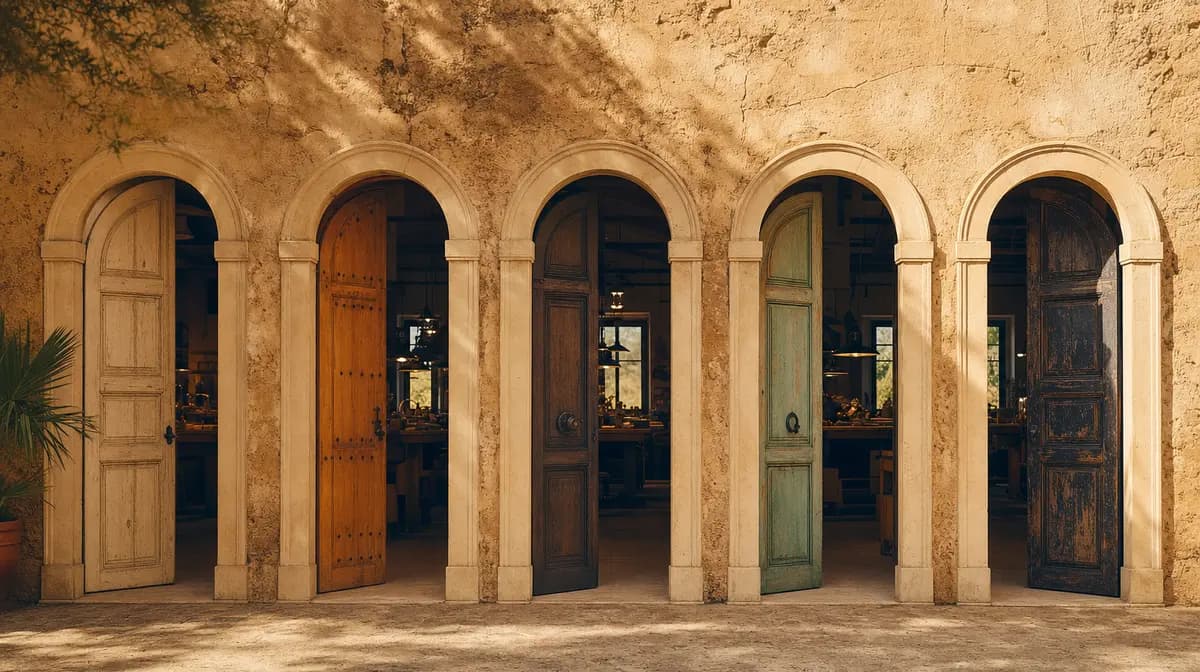
Six people, six questions, same week, same studio. A single homepage cannot answer all six well. We tried for about a year. Then we split the studio into six domains, each with its own voice, its own pricing, its own audience, its own language. They share one office, one team, one knowledge graph, and one Google Business Profile. From the outside they look like six independent projects. Under the hood they are six doors into the same workshop.
This post is the map.
Why six surfaces instead of one#
The temptation when you do many things is to put them on one site, behind one menu, under one brand statement. We tried. It produces a homepage that is either too generic to convince the boutique hotel owner or too technical to make sense to the career changer. Every paragraph apologises to a different reader. Conversion drops on both ends.
The argument for splitting is the inverse. A site that is built for one audience can speak to that audience without compromise. The hotel owner gets a clean B2B page with prices and a calendar link. The career changer gets a learning platform with no signup wall and a Discord. The Hamburg team gets photos of a finca and a four-day program. The engineer gets a repo grid and architecture diagrams. The researcher gets a live feed of nine AI citizens deciding what to do next.
What you lose by splitting is brand consolidation. What you gain is conversion clarity. We made the trade because a confused visitor on the wrong page costs more than a fragmented brand. The link layer between the six domains, Schema.org markup with parentOrganization and subOrganization pointing in both directions, plus one shared Google Business Profile, is meant to help ChatGPT, Perplexity, Bing Copilot and Google AI Mode read the cluster as one entity. Crawlers see six connected surfaces. Visitors see exactly the door they came for.
studiomeyer.io, the studio itself#
studiomeyer.io is the B2B studio. This is where the actual paying work happens. We build websites, AI systems and custom MCP servers for small and mid sized businesses and for agencies that need a whitelabel back office.
Pricing is on the site and stays the same whether you find us through a referral or cold. Webdesign Foundation is 2,500 euros at a fixed price, the Growth package 3,500, Individual from 6,500, each payable once or in twelve monthly instalments. The first twelve months of StudioMeyer Care are included, after that 149 euros a month. AI systems are quoted to fit the project. The AI Connector now also has Standard and Pro plans with setup and monthly support; the specific quote depends on the integration. The first call is always free, booked through Cal.com, taken either at our office at Avinguda de Joan Miró 138 in Palma or over video.
The audience is owners and managing directors who want one partner to handle design plus AI integration without juggling three vendors. Hospitality and real estate on Mallorca, agencies in the DACH region, and a growing tail of clients in Hamburg, Berlin, Munich, Zurich and Vienna. The one proof point we lead with is the count of AI citations in Bing and Copilot. As of May 2026 our own site gets cited there about 4,500 times per month. The number lives in lib/proof-metrics.json on the site itself and comes from a dated Bing Webmaster Tools screenshot, not from a marketing slide. If you want to see the dashboard before you talk to us, ask, and we will share it.
What studiomeyer.io is not: a self serve product, a tool you click through, or a quick fix shop. Every project starts with a conversation. Every site is built for one specific business.
studiomeyer.academy, the open classroom#
studiomeyer.academy is the free learning platform. We launched it in April 2026 and pivoted away from the original Pro tier in the same month. It has been completely free since then. No paywall, no signup to read, no hidden upsell. You can land on it, finish a lesson, and never give us an email address.
The platform is built as six levels. Level 1 explains what LLMs actually do, how to spot hallucinations, and how prompting works. Level 2 covers productive day to day use of Claude, ChatGPT and Gemini. Level 3 introduces no code automation with Zapier and n8n. Level 4 is where it gets interesting, memory first workflows with the Model Context Protocol, hooks and skills. Level 5 covers multi agent systems, the CEO worker pattern, critic and research and analyst agents, cross agent memory. Level 6 is full stack AI systems, building, deploying and selling your own MCP server.
The content lives in three languages, German, English and Spanish. Beyond the levels we ship a stack of recipes with step by step validators, playbooks for switching between Claude, Cursor and Codex, and 48 interlinked concept pages that explain individual terms. There is also an npm package called mcp-academy that turns the academy into an MCP server with 23 learning tools. You install it once, point Claude Desktop or Cursor or Codex at it, and the academy becomes a tutor that lives inside your editor.
The audience is career changers, job seekers and solo founders who want to become AI operators without paying for a bootcamp. The Discord is small, on purpose, and Matthias reads along. It is not a sales channel.
aifinca.es, the four day retreat#
aifinca.es is the retreat format. Founded in 2026, this is where we run small group workshops on a finca in the Mallorcan interior, away from the tourist coast. The tagline is "KI lernen wo andere Urlaub machen" which translates roughly to learning AI in a place other people come to vacation. The hook line is "operator depth instead of conference bingo".
There are four formats. KI im Alltag for solo learners building their own assistant, four to eight seats. KI fürs Business for management teams building an agent fleet, capped at four. Team KI-ready for full teams who bring their work and leave with a working system, capped at six. And Einzelunterricht, full one on one custom format.
Each retreat runs four consecutive work days. Accommodation and meals are included. The fincas we work with sit in the hinterland, stone walls and olive trees and long wooden tables under pergolas. Pool and quiet when you need them, real conversation when you want them. The location rotates by season and program. Pricing is not on the site yet because the format is genuinely custom per group and we have not found a single price that does not lie about one of the four formats. So it is "auf Anfrage", on request, and we quote per group.
This is the format for people who do not learn well on Zoom and do not get a return on a conference ticket. It is also the format that lets us teach the deep operator work that does not fit into a written lesson.
matthiasmeyer.tech, the workshop floor#
matthiasmeyer.tech is the open-source hub of the studio. It is where the building blocks I use in studio projects get published under MIT before anyone else sees them. The framing on the site is simple: I build the MCP servers, memory engines, agent patterns and security layers I need for my own AI stack. Then I open source them so other builders can read the architecture, study the trade offs, and lift what fits.
The hero of the site is a 3D force graph of all the repos. Nodes are projects, edges are which one uses or extends which. You can drag a node, hover for details, click through to GitHub. The eight cornerstone projects are Local Memory MCP (persistent local memory for Claude, Cursor and Codex, SQLite plus FTS5 plus a knowledge graph, no cloud, one command to install), Personal Suite MCP (forty nine local first productivity tools across six modules), MCP Video (cinema grade video production via MCP, eight tools on ffmpeg and Playwright), Agent Fleet (multi agent orchestration for Claude Code), AI Shield (LLM security toolkit covering injection, memory canary and circuit breakers), Darwin Agents (self evolving prompts with GEPA style reflective optimisation), MCP Armor (a drop in Rust sidecar for MCP servers), and n8n Templates (production patterns with cross session memory).
Plus a long tail of secondary projects, the MeetMyAgent SDK, an AI Shield Python port, an MCP Stdio Shellguard, the MCP Spec Migrator 2025-11-25, MCP Tenant Pair, MCP Hook Conformance and several more. Over 40 MIT licensed repos in the studiomeyer-io GitHub organisation in total. All with docs. All with tests. All written for builders who want to read code, not buy a SaaS.
If studiomeyer.io is the storefront, matthiasmeyer.tech is the workshop floor with the lights on.
meetmyagent.io, an AI agent for every business#
meetmyagent.io is the flagship. Every business gets its own AI agent there, one that speaks for it. People talk to it on its own page or in a chat window on the business's website, no matter who built the site. Other AI agents reach it over A2A, the open standard agents use to talk to each other, by reading its signed card.
The owner sets the agent up from the assistant they already use, over MCP, or by hand in a console: describe what the business does, add services and knowledge, then give an explicit yes. Requests land in the inbox, and the owner decides what goes out. Every agent that goes live is listed in the directory, next to A2A agents that run elsewhere and were connected by their card.
aklow-labs.com, the research lab#
aklow-labs.com is the research arm. Founded in 2026, this is where we run the kind of experiment that does not yet have a customer. The first live experiment is Polis: a fictional Mediterranean town on Mallorca where AI citizens live over time. Different model tiers side by side, each citizen with their own job, their own money, decisions that build on each other. We watch how long term decision making differs across model tiers in a way that single shot benchmarks cannot show.
The second live experiment is Chess. Here we run different chess experiments to measure how tools, memory and prompt evolution change LLM agent behavior over time. AI agents play against each other, every move goes through a reasoning pipeline with clickable stations, all tool calls and decisions are open to inspect.
The stack underneath is the same one we run for clients on studiomeyer.io. LangGraph for orchestration, Temporal for durable workflows with retry, Langfuse for observability with span tags by model tier, PostgreSQL with LISTEN/NOTIFY for the live feed, React Three Fiber for 3D surfaces, plus our own darwin-agents and darwin-langgraph npm packages. Background agents keep the lab running, from roadmap calls and read only code reviews to research, analytics and visibility. We eat our own dog food in public.
What ties the six together#
An office at Avinguda de Joan Miró 138 in Palma de Mallorca. Same address, same phone number (+34 605 24 67 81), same Google Business Profile (cid 16494892045182628389), same founding. Same stack underneath, Next.js plus TypeScript plus Tailwind plus PostgreSQL plus Anthropic Claude plus the Model Context Protocol, hosted on Hetzner Germany behind Cloudflare. The Schema.org markup on each of the six sites declares its parent and sibling sites explicitly, so an LLM crawler that lands on aifinca.es knows it is reading a sibling of studiomeyer.io and aklow-labs.com.
The deeper tie is the knowledge graph. All six domains read and write to the same mcp-nex memory layer. When the academy learns something new about MCP patterns from teaching it, the studio sees that update. When the Polis lab on aklow-labs.com discovers a new agent strategy, the finding flows back into the Darwin Agents library on matthiasmeyer.tech. That is the ecosystem dividend. Every insight makes all six domains better at once, instead of dying inside a project folder no one reopens.
Which door for which need#
If you run a business and need a website, an AI system or automation, the door is studiomeyer.io. Booking is via Cal.com, the first call is free, and prices are on the page.
If you want to learn AI without paying anything, the door is studiomeyer.academy. No signup to read. Discord linked from the site if you want company.
If you want to spend four days on a finca with your team or by yourself and leave with a working system, the door is aifinca.es. Send a short message, we reply with format options.
If you want the source code, the architecture diagrams or the npm packages, the door is matthiasmeyer.tech and through it the studiomeyer-io GitHub organisation.
If you want your business to have its own AI agent that people and other AIs can talk to, the door is meetmyagent.io.
If you want to watch a multi agent experiment unfold and read the open code while it runs, the door is aklow-labs.com, with Polis and Chess as live sub paths.
You do not have to pick correctly. Whichever site you land on, the contact form reaches the same inbox and the same team reads it. The six domains are six entry points, but the workshop is one room.
