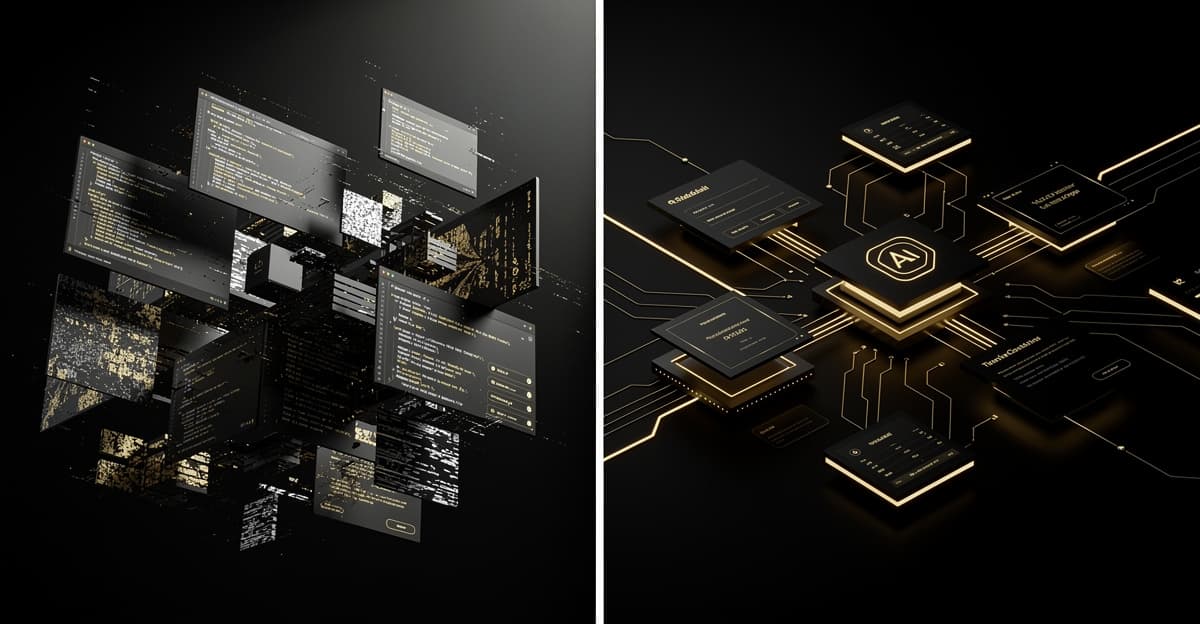
Vibe Coding vs. Professional AI Development: The Difference That Costs Money
The same AI. The same tools. Two completely different results.
A startup builds an app with Cursor in three days. A professional team builds an app with Cursor in three days. Both use the same AI model. But one app crashes after three weeks — and the other has been running stable for months.
The difference isn't the AI. The difference is who controls it.
What Vibe Coding Means in Practice#
With Vibe Coding, you describe your goal in natural language. The AI writes the code. You test whether it works. If yes: move on. If no: describe the problem, the AI corrects it.
This sounds efficient. And for simple projects, it is. But for anything beyond a prototype, a problem emerges that's initially invisible:
You're building on a foundation nobody understands.
A Real-World Analogy#
Imagine you're having a house built. The architect shows you a finished model — exactly as you wanted. You move in. Everything looks perfect.
Three months later: a crack in the wall. You call the architect. He says: "I didn't check the structural integrity. But it looked good."
That's exactly what happens with Vibe Coding. The software looks finished. It works — today. But nobody checked whether the foundation is solid.
The Hidden Costs of Vibe Coding#
1. Security Vulnerabilities Nobody Sees#
An investigation of Lovable projects — a popular Vibe Coding platform — found 170 critical security vulnerabilities in 1,645 publicly accessible apps. Open database access. API keys in source code. Missing authentication.
These aren't exotic edge cases. These are basics that every professional developer handles instinctively — but that an AI doesn't automatically address unless explicitly prompted to do so.
2. Technical Debt from Day One#
CodeRabbit analyzed over 200,000 pull requests and found: AI-generated code has 1.7 times more major issues than human code. And 2.74 times more security vulnerabilities.
This means: you save time upfront — and pay it back multiple times later. With bugfixes. With rewrites. With outages.
3. The Maintenance Problem#
Software is never done. It needs updating when dependencies change. It needs extending when new requirements arise. It needs fixing when bugs appear.
If nobody on the team understands the code, every one of these tasks becomes a gamble. You prompt the AI, hope for the best — and don't know whether the change broke three other things.
4. Vendor Lock-in Through Ignorance#
If you don't understand your code, you're dependent on the tool that wrote it. If the AI changes its behavior or the tool shuts down, you're left with code nobody can maintain.
What Professional AI Development Does Differently#
Professional AI development uses the same tools. The difference lies in five points:
1. Code Understanding#
An experienced developer reads every suggestion the AI makes. They understand what the code does — and what it doesn't. They recognize when the AI made a poor decision and correct it before it becomes a problem.
2. Architectural Knowledge#
The AI can write individual functions well. But it doesn't think about the big picture: How does the application scale? How is the data structured? How do systems communicate with each other?
An architect plans the structure. The AI helps with implementation.
3. Testing and Quality Assurance#
Professional development means: automated tests, code reviews, staging environments. Nothing goes to production without being verified. That's the difference between "it works on my machine" and "it works for 10,000 users."
4. Security by Design#
Professional developers think about security from the start: input validation, authentication, encryption, GDPR compliance. These things don't happen automatically — they must be actively built in.
5. Maintainability#
Code that a human understands can be maintained by a human. Code that only an AI understands may, in the worst case, be unmaintainable.
The Direct Comparison#
| Aspect | Vibe Coding | Professional AI Development |
|---|---|---|
| Speed (v1) | Very fast | Fast |
| Speed (v2+) | Slow to impossible | Consistently fast |
| Security | Uncontrolled | Verified |
| Maintainability | Low | High |
| Scalability | Unknown | Planned |
| Cost (short-term) | Very low | Moderate |
| Cost (long-term) | High to catastrophic | Predictable |
| Suitable for | Prototypes, personal projects | Business-critical software |
When Is Vibe Coding the Right Choice?#
Vibe Coding has its place — and it's not small:
- Testing prototypes: You have an idea and want to see if it works? Vibe Coding is perfect.
- Internal tools: A quick dashboard used only by your team? Why not.
- Learning: Anyone who wants to understand how software works won't find a better starting point.
- Personal projects: Your personal website, a hobby project, an experiment.
When Do You Need Professional Development?#
As soon as any of these conditions apply:
- Customer data is involved (GDPR obligation)
- Revenue depends on the software
- The software must function and grow long-term
- Multiple users or systems are involved
- The software is publicly accessible
In these cases, "vibes" aren't enough. You need someone who understands the code, who plans the architecture, and who takes responsibility for quality.
Our Model at StudioMeyer#
We combine the best of both worlds:
AI Speed — We use AI tools intensively for research, code generation, and automation. This makes us faster than traditional agencies.
Human Control — Every line of code is understood, reviewed, and tested. We know what the code does — and why.
Transparent Quality — 1,604 automated tests. Lighthouse scores above 90. Code reviews on every change.
The result: projects completed in weeks rather than months — without the risks that Vibe Coding brings.
Conclusion#
The question isn't whether you should use AI. The question is how.
Vibe Coding is a start. But for anything that costs money, processes data, or affects customers, you need more than vibes. You need someone who uses AI as a tool — not as a substitute for expertise.
Ready for AI development without risk? Learn more about our AI Server — or talk to us directly.
