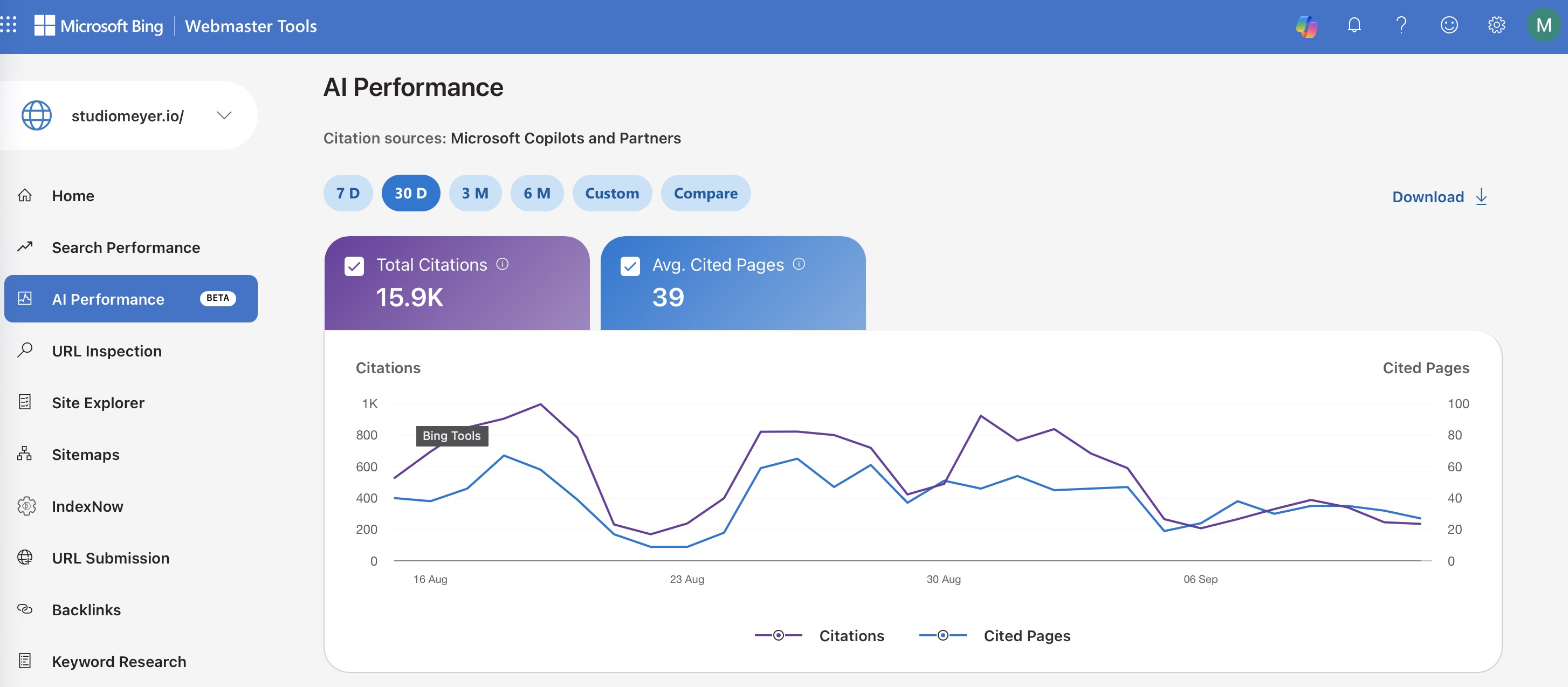
Since March 2026, we have documented how often our website is cited in supported AI answers. The current measured value is 15,900+ citations in a 30-day window (as of 14 September 2026). The source is the Bing Webmaster Tools AI Performance report: Microsoft Copilot, AI answers in Bing and selected partners. We worked on content and technical readability during this period. The trend shows the development, but does not prove any individual intervention’s contribution.
GEO means Generative Engine Optimization: making content discoverable and useful as a source in relevant AI answers. It complements SEO. Search-based AI answers also use search indexes and websites, so the foundations overlap. A citation measures something different from an organic click.
Why GEO Matters#
Search results and AI answers differ in presentation and source selection. Their technical foundations can overlap.
A good search position does not guarantee a mention in an AI answer. Retrieval, the question and source selection also matter. We therefore check both separately.
A citation is neither a visit nor an enquiry. We therefore assess business value separately: which visits come from AI referrals, and which enquiries or completed actions follow? This does not establish a universal conversion rate.
The Starting Point#
StudioMeyer was not mentioned in our open test questions in early March 2026. This was a sample in the interfaces we used, not proof of complete invisibility across all AI systems.
That prompted the sprint. Our recorded counts at the time were 100/100 Lighthouse SEO, more than 145 blog articles and 680+ AI tools. Even so, we were absent from the tested answers.
The Strategy: Four Pillars#
Pillar 1: AI Discovery Stack#
Our discovery stack combines crawlable content, structured facts and supplementary files for compatible clients. These files serve different purposes. Google requires no special AI files or additional schema types for AI Overviews and AI Mode.
- llms.txt: A supplementary overview and links under an open format proposal. It is not an access control like robots.txt or a guaranteed requirement for AI citations.
- agents.json: Describes available interfaces for clients supporting this format. It is not the WebMCP standard or a requirement for Google AI answers.
- agent-card.json. A2A Protocol (Agent-to-Agent) by Google for automatic agent discovery.
- robots.txt. 20 AI bots explicitly allowed: GPTBot, ClaudeBot, Claude-User, Claude-SearchBot, PerplexityBot, Google-Extended, Applebot-Extended, Meta-ExternalAgent, and more.
- JSON-LD Schema. 12 schema blocks: Organization, ProfessionalService, WebSite, WebPage with SpeakableSpecification, FAQPage, Person, BreadcrumbList, and more.
- Sitemap. 640+ URLs with hreflang tags for all three languages (DE/EN/ES).
- .well-known/mcp.json. MCP server discovery for AI clients.
Our internal discovery-stack check at the time returned 100/100. This reflects our own checklist, not an industry standard or proof of placement.
Pillar 2: Entity SEO#
Clear names and consistent facts help identify a business across sources. Search terms and the context of a question still matter.
What we did:
- Entity unification. In over 45 files, we corrected different spellings ("StudioMeyer.IO", "StudioMeyer.io", "Studio Meyer") to a consistent "StudioMeyer". JSON-LD, OG tags, meta tags, titles. All consistent. At the time, our internal checklist recorded 95% entity consistency.
- Social Profile Entity Linking. 6 platforms (LinkedIn, GitHub, Instagram, X, Reddit, dev.to) linked in Schema.org sameAs, bidirectional links from each platform back to the website.
- Directory listings. Clutch.co and other industry directories to strengthen entity signals.
Consistent names and current profiles help people and machines connect facts. They do not establish a fixed citation multiplier or a particular ranking improvement.
Pillar 3: Citation-Optimized Content#
The most surprising insight: our blog content was cited immediately. Our service pages initially at zero percent. In this sample, technical articles received more citations than our service pages.
What works:
- Comparison articles with tables (our "MCP vs REST API vs WebMCP" was cited immediately)
- Verifiable facts linked to original sources; add numbers only when they are relevant and supported.
- Every paragraph must work standalone. AI systems extract individual passages as quotes
- FAQ schema on every service page with 5-8 real questions
- Authority links to Schema.org, W3C, Anthropic, and other recognized sources
What doesn't work:
- Vague marketing copy ("we offer innovative solutions")
- Dependent paragraphs ("as mentioned above")
- Pages without measurable facts
Pillar 4: Homepage as Entity Hub#
The homepage was entity-optimized: founder name, founding year, tech stack, and location appear in visible text, not just in meta tags. A visible stats bar shows the key numbers (680+ tools, 100/100 SEO, 15,900+ citations). Every paragraph functions as a standalone LLM quote.
The Results#
AI Citations in 30 Days: Grown Since Mid-March 2026#
- 15,900+ citations in 30 days in Bing and Copilot (as of 14 September 2026), dated screenshot: /proof/bing-ai-citations-2026-09-14-30d.png
- 39 average cited pages per day: Microsoft counts unique pages from our domain displayed as sources per day, averaged over the selected window. This is not a per-answer measure or proof of ranking or brand authority.
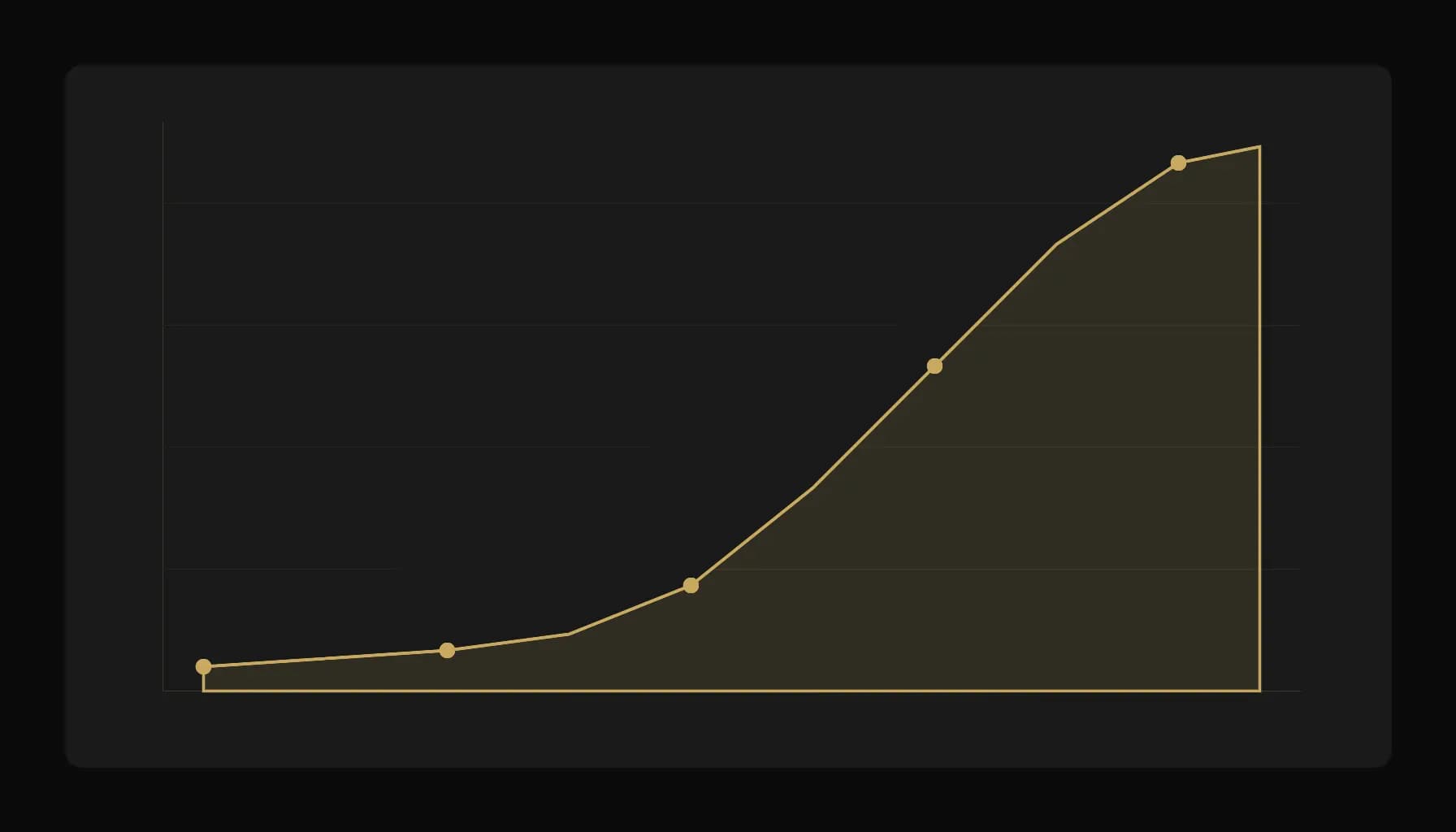
- Trend: Grown since mid-March 2026, starting at 304. In the 3-month window: 53,000 AI citations in 3 months.
- Caveat: Bing Webmaster Tools data is sampled and can be retroactively adjusted by Microsoft. Other LLMs (ChatGPT, Claude, Perplexity, Gemini, Grok) don't expose comparable per-domain citation data. The 15,900 figure comes from the AI Performance report; Microsoft counts Copilot, AI answers in Bing and selected partners there. A citation is not a click or a visit.
- Grok organic mention (13 April 2026): Matthias asked Grok for the best AI agencies on Mallorca without mentioning any brand. StudioMeyer was named organically. External LLM validation with no brand-prompt.
Discovery Stack#
- GEO Score: 73/100 (Simulate), Discovery Stack 100/100, Freshness 100/100
- All AI discovery files live: llms.txt, agents.json, agent-card.json, mcp.json, webmcp
- 20 AI bots explicitly allowed in robots.txt, 0 blocked
Content Metrics#
- 104 blog articles in three languages (DE/EN/ES)
- 11,257+ automated tests for code quality
- Check delivery: Measure TTFB and user-facing performance by URL, device and date; a good SEO lab score does not replace field measurements.
What You Can Do Right Now#
In One Hour#
- Check crawler access: Check OAI-SearchBot for ChatGPT search and Googlebot for Google Search, including CDN and firewall rules. GPTBot controls training; Google-Extended is not a Google Search ranking switch.
- Consider llms.txt for compatible clients. A simple text file in your root: who you are, what you offer, what makes you unique
- Check JSON-LD schema. Organization, LocalBusiness, and Person schema should be complete
In One Day#
- Check entity consistency. Is your company name spelled the same everywhere? JSON-LD, OG tags, meta tags, titles?
- Optimize blog articles. Make every paragraph standalone. Add facts and numbers. Add FAQ schema.
- Social Profile Linking. Add LinkedIn, GitHub, Instagram to Schema.org sameAs, set up bidirectional links.
Ongoing#
- Write technical deep-dives. Comparison articles, how-tos with concrete numbers, FAQ-formatted guides
- Directory listings. Clutch, GoodFirms, Sortlist, DesignRush, industry-specific directories
- Update content when facts change: Keep measurement dates and time windows visible. Do not manufacture freshness by changing only dates or headers.
The Future: GEO Will Become Standard#
GEO today is where SEO was 15 years ago: a niche topic that will soon become indispensable. AI systems will get better at detecting quality signals, and competition for AI citations will increase.
The documented three-month window shows 53,000 citations (as of 14 September 2026). The latest 30-day value declined from July; different windows describe different parts of the development. This example illustrates our measurement approach, not a result guarantee for other businesses.