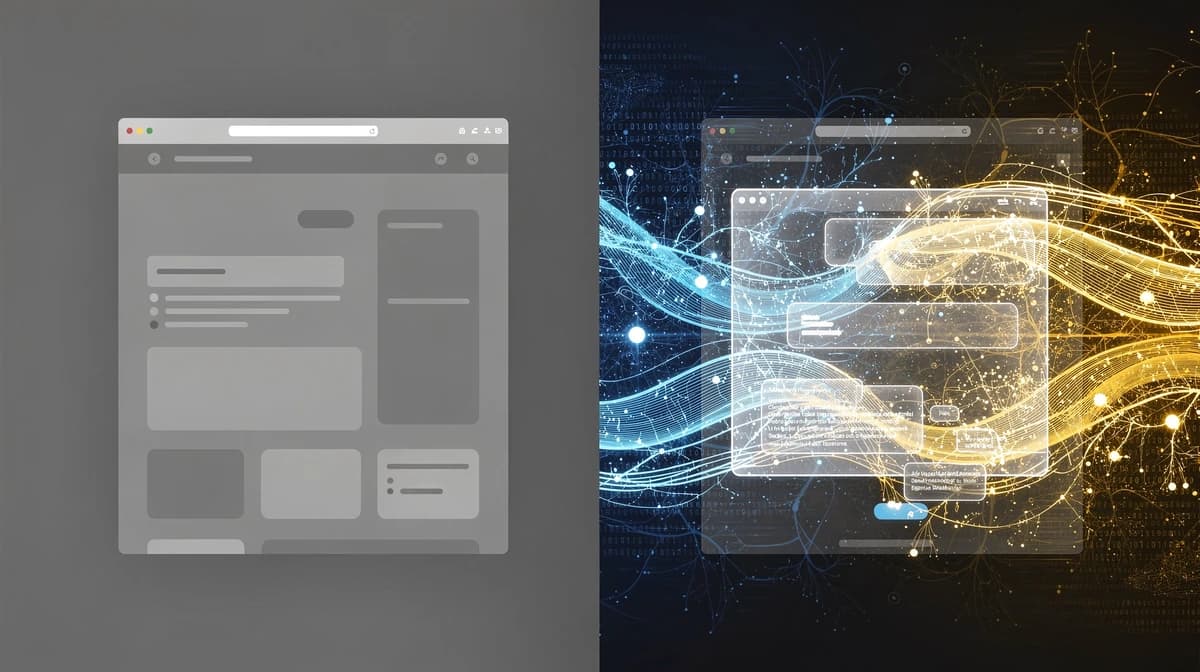
Two websites. Both sell the same thing. Both look good. But when an AI agent visits them, completely different things happen.
This isn't a hypothetical scenario. It's happening right now. And over the next few years, it will determine which businesses tap into a new traffic source -- and which remain invisible.
What Happens When an AI Agent Visits a Classic Website#
Imagine someone asks Claude or ChatGPT: "Find me a web design agency with experience in the restaurant industry."
The agent visits a classic website. What it finds:
HTML Soup#
<div class="hero-section">
  <h1>We craft <span class="highlight">digital experiences</span></h1>
  <p>Lorem ipsum dolor sit amet, consectetur adipiscing elit.
  We are your creative agency for modern web projects.</p>
</div>
The agent now has to guess:
- What exactly does this agency do? "Digital experiences" is not a clear service.
- Do they have restaurant experience? Somewhere on the website there might be a reference project. Or not.
- How much does it cost? No structured pricing information.
- How do you book? A contact form. Which the agent can't fill out.
The PDF Analogy#
When an AI agent analyzes a classic website, it's like a human reading a scanned letter. The information is there, but it's not structured. The agent must:
- Load and parse HTML
- Separate relevant content from navigation, footer, ads
- Interpret texts and draw conclusions
- Hope its interpretation is correct
It works -- approximately. But it's fragile. If the website changes its layout, the interpretation breaks. Are the prices in a PDF instead of on the page? The agent might not find them. Is the reference gallery an image carousel without alt text? Invisible.
What Happens with an AI-Ready Website#
Same question: "Find me a web design agency with restaurant experience."
The agent visits an AI-Ready website. What it finds:
Structured Discovery#
First, it calls /.well-known/agents.json and gets:
{
  "tools": [
    {
      "name": "browse_portfolio",
      "endpoint": "/api/v1/portfolio",
      "method": "GET",
      "parameters": {
        "industry": {
          "enum": ["immobilien", "gastronomie", "handwerk", "technologie"]
        }
      }
    },
    {
      "name": "request_quote",
      "endpoint": "/api/v1/quote",
      "method": "POST"
    },
    {
      "name": "schedule_consultation",
      "endpoint": "/api/v1/consultation",
      "method": "POST"
    }
  ]
}
No interpretation needed. The agent knows immediately:
- This agency has gastronomy as an explicit category
- It can filter portfolios
- It can request a quote
- It can book an appointment
The API Analogy#
When an AI agent uses an AI-Ready website, it's like a program calling an API. Clearly defined inputs, clearly defined outputs. No guessing, no parsing, no hoping.
GET /api/v1/portfolio?industry=gastronomie
→ 200 OK
→ { "projects": [{ "name": "Zur Alten Post", "type": "Restaurant", "results": "+280% reservations" }] }
The difference is fundamental. Not slightly better. Fundamentally different.
The Direct Comparison#
| Criterion | Classic Website | AI-Ready Website |
|---|---|---|
| How an agent finds it | Search, HTML analysis | agents.json discovery |
| How an agent understands it | Text interpretation | Structured data |
| What actions an agent can take | None (read only) | Call tools (book, inquire, filter) |
| Reliability of information | Fragile (layout-dependent) | Stable (API-based) |
| Speed | Slow (parse entire HTML) | Fast (targeted API call) |
| Multilingual support | Agent must detect language | Explicitly declared |
| Machine-readable pricing | Rare | Standard |
| Automatic booking | Not possible | Directly via API |
"But My Classic Website Is Found by AI Too"#
Yes. And that's an important point. ChatGPT can indeed analyze classic websites. It reads the HTML code, interprets the text, and draws conclusions. In many cases, it works well enough.
But "well enough" is not "reliable." And certainly not "optimal."
Three problems with HTML interpretation:
1. Context dependency. "From 199 euros" on a landing page could be the starting price. Or the price per month. Or per page. An API endpoint delivers { "price": 199, "currency": "EUR", "billing": "monthly" }. No ambiguity.
2. Fragility. Websites change their design regularly. A redesign, a new CMS, a restructured navigation -- and the HTML patterns the agent learned no longer work.
3. Incompleteness. An agent reading HTML only sees what's on the page. An API endpoint can deliver everything -- including data never displayed on the website (e.g., availability, technical specifications, internal categorizations).
The Elephant in the Room: Today 95%+ of Traffic Comes from Humans#
Honest assessment: the vast majority of websites get their traffic from humans who open a browser and type a URL or search Google. The share of AI agent traffic is still marginal today.
And that's exactly where many people dismiss it. "Why should I invest in something that has no measurable impact today?"
The answer is the same as for SEO in 2001. Or mobile optimization in 2008. Or structured data in 2015. The traffic comes later. The investment must happen sooner.
Why? Because:
- The infrastructure is being built now. Google is experimenting with WebMCP in Chrome. Anthropic has released MCP. Microsoft is integrating agents into Copilot.
- Usage is growing exponentially. ChatGPT has integrated web search. Claude can analyze websites. Perplexity, Gemini, and others follow.
- The competitive advantage comes before mass traffic. Those who are AI-Ready today will be preferred in the first waves -- because agents will favor working endpoints.
What Really Changes#
The change isn't "more traffic from robots." The change is fundamentally deeper:
1. From Displaying to Interacting#
Classic websites are shop windows. You look in, see the products, and have to act yourself (call, fill out a form, go in). AI-Ready websites are vending machines. You say what you want and you get it.
That sounds like a small difference. It's not. It's the difference between "Visit our website" and "Tell your AI assistant what you need."
2. From Search to Action#
Today: User searches → finds website → reads information → contacts business → waits for response → makes decision
Tomorrow: User tells agent what they need → Agent finds suitable providers via agents.json → Agent queries prices → Agent books appointment → User confirms
The entire middle of the funnel -- information, comparison, initial contact -- gets automated. Not by the website. By the customer's agent.
3. From One-Time Visit to Permanent Interface#
A classic website is visited. An AI-Ready website is used. The difference: a visit is an event. An API interface is a permanent connection.
Once an agent knows that studiomeyer.io/api/v1/portfolio delivers real estate projects, it will use that endpoint again and again -- for every user who asks about real estate web design. That's not a one-time click. That's a channel.
What an AI-Ready Website Concretely Needs#
The good news: AI readiness isn't a complete rebuild. It's a supplement to the existing website.
Must-Have (Basics)#
- agents.json at
/.well-known/agents.json-- the discovery file - At least 3 API endpoints: retrieve services, make contact, filter portfolio/products
- JSON-LD/Schema.org markup -- structured data that also helps SEO
- agent-card.json -- for A2A-capable agents
- CORS headers -- so agents can reach the APIs
Nice-to-Have (Advanced)#
- AI-Ready score endpoint -- so others can check how AI-Ready their website is
- Industry-specific tools -- reservation, appointment booking, price calculator
- WebMCP support -- for the next generation of browser-integrated agents
- A2A endpoint -- so agents can communicate directly with each other
- Event tracking for agent traffic -- measure what agents do
Not Needed (Overkill for Most)#
- Your own MCP server
- Real-time streaming for agents
- Complex multi-agent orchestration
Strategic Investment, Not Urgent Emergency#
This article isn't meant to spread panic. Your classic website works. It will still work tomorrow. And the day after.
But: the direction is clear. AI agents will become their own channel -- alongside organic search, paid ads, and social media. Ignoring this channel means you lose nothing today. But you miss something tomorrow.
The mobile parallel is apt. In 2010, you could survive just fine without a mobile website. By 2015, it got uncomfortable. By 2020, it was business-critical. With AI readiness, we're roughly at 2011-2012.
The Three Stages to an AI-Ready Website#
Stage 1: Immediately Doable (1-2 Days)#
- JSON-LD markup for all important pages
- Schema.org data (Organization, Product, Service, FAQ)
- Update robots.txt and sitemap.xml
- Investment: Minimal. This is SEO work that pays double dividends.
Stage 2: Short-Term Achievable (1-2 Weeks)#
- Build API endpoints for core functions
- Create agents.json and agent-card.json
- Set CORS headers
- Health endpoint for monitoring
- Investment: Moderate. Worth it for any business with digital services.
Stage 3: Strategic Expansion (Ongoing)#
- Implement industry-specific tools
- Integrate A2A support
- Measure and optimize agent traffic
- Build new endpoints based on agent usage
- Investment: Long-term. For businesses that take agent traffic seriously as a channel.
Conclusion: Not If, but How Fast#
The question isn't whether AI agents will become relevant. They already are -- just not at scale yet. The question is how quickly you prepare your website for them.
Classic websites won't die. But in a world where agents make more and more decisions, they'll have a structural disadvantage. Not because they're bad. But because AI-Ready websites simply can do more.
The comparison "AI-Ready vs. classic" is ultimately like "website with SEO vs. website without SEO." Both work. But one gets found. The other doesn't.
And with AI agents, it's not just about being found. It's about being used. About actions. About revenue.
The technology is here. Standards are emerging. Adoption is coming. The only question that remains: will you wait until everyone does it? Or will you be one of the first?
