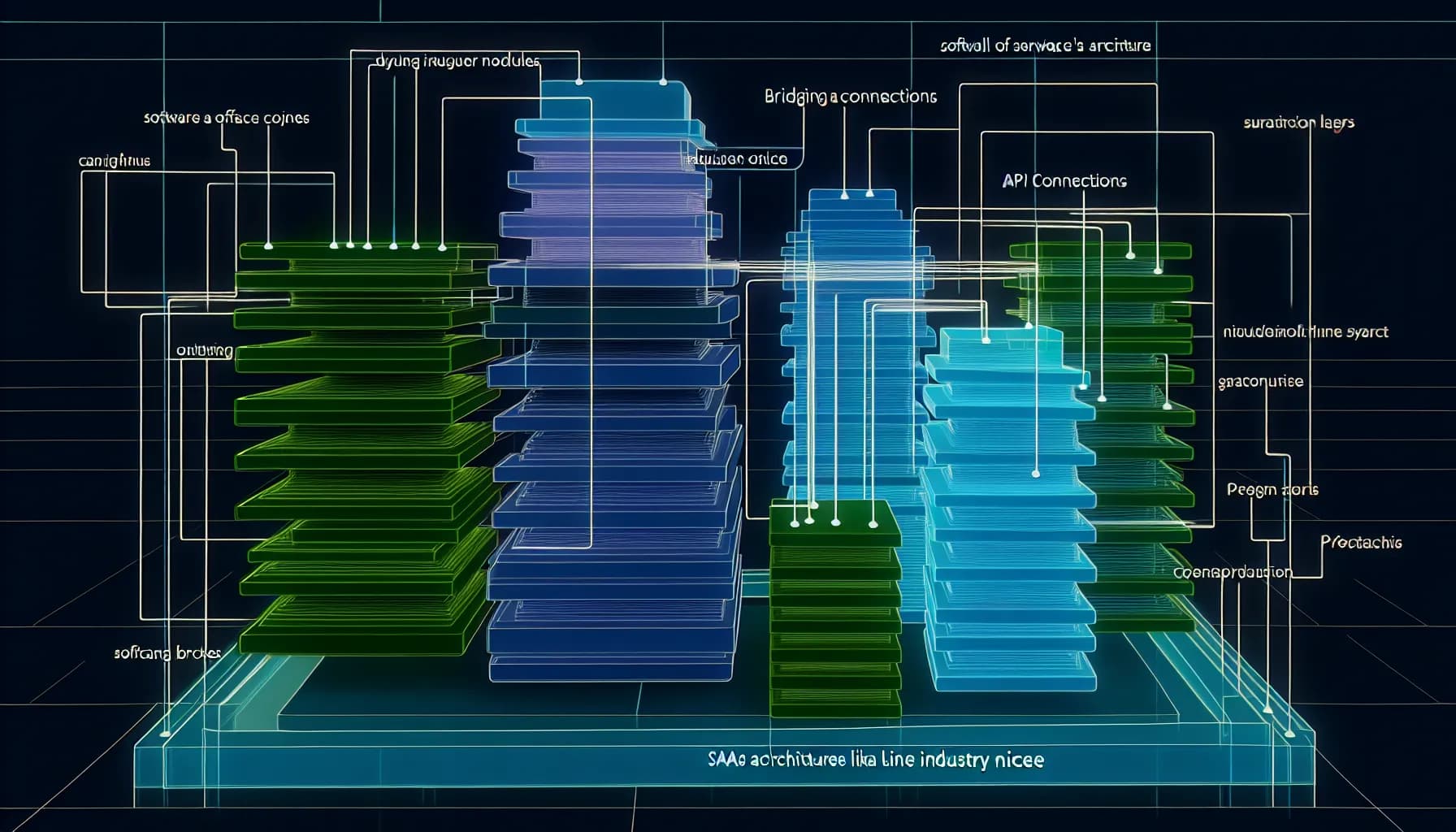
The SaaS market has fundamentally changed. The era of large, horizontal platforms trying to be everything for everyone is ending. In their place, specialized solutions that understand a single industry better than any generalist ever could are taking over.
The numbers speak for themselves: Vertical SaaS is growing at 32% annually, while horizontal solutions manage only 12% growth. This article explains why niche solutions dominate the market and what this means for businesses that use or develop software.
Horizontal vs. Vertical: What's the Difference?#
Horizontal SaaS solves a universal problem across industries. Slack for communication, Salesforce for CRM, Notion for documentation. These tools work in any company, whether a bakery or an investment bank.
Vertical SaaS solves industry-specific problems. Procore for construction management, Toast for restaurants, Veeva for pharma. These tools understand the language, workflows, and regulatory requirements of a specific industry.
Why Vertical SaaS Wins#
- Higher conversion rates: Industry-specific software directly addresses target audience pain points. Conversion rates are 3-5x higher than generic solutions
- Lower churn rates: When software is deeply integrated into industry workflows, switching barriers are significantly higher. Average churn: 3-5% vs. 8-12% for horizontal SaaS
- Higher prices: Industry expertise justifies premium pricing. Vertical SaaS achieves 2-3x higher ARPU than comparable horizontal solutions
- More efficient sales: The target audience is clearly defined. Marketing through trade media and industry associations is more targeted and cost-effective
The Super-Vertical Trend: Going Even Deeper#
In 2026, we're seeing a trend within the trend: Super-Vertical SaaS. Solutions built not just for an industry, but for a specific segment within an industry.
Instead of "software for restaurants," it's now "software for ghost kitchens" or "software for fine dining with wine lists." Instead of "software for doctors," it's "software for orthodontists with aligner practices."
Why this works:
- Even deeper industry knowledge: The product speaks the language of a micro-niche
- Almost no competition: In a super-niche, there's often zero competition
- High willingness to pay: Whoever offers the only tool for a specific problem can charge premium prices
- Efficient sales: The target audience is clearly defined and easy to reach
Rule of thumb: If you can find a market with at least 5,000 potential customers who would each pay $200-500 per month, you have a viable super-vertical business.
Usage-Based Pricing: The New Standard Model#
Alongside the Vertical SaaS shift, pricing is changing fundamentally. The movement is away from rigid seat-based licenses toward usage-based billing.
Why Usage-Based Pricing Wins#
- Lower entry barrier: Customers pay only for what they use
- Natural expansion: As the customer grows, revenue grows automatically
- Fairer pricing: A one-person operation pays less than a 50-person team
- Better retention: Customers who actively use the product churn less
Hybrid Pricing as Best Practice#
The most successful Vertical SaaS products combine a fixed base fee with variable components:
- Base package: $99-299/month (covers fixed costs, provides predictability)
- Variable component: Based on transaction volume, API calls, or active users
- Premium add-ons: Advanced analytics, integrations, priority support
API-First Architecture: The Technical Foundation#
Modern Vertical SaaS is built API-first. Every function is accessible via an interface before it gets a user interface.
Why API-First is Critical#
- Integration: Industry-specific software must connect with existing systems
- Extensibility: Partners and customers can build their own integrations
- Headless deployment: The backend can serve different frontends
- AI readiness: APIs are the foundation for AI integrations and automation
The Composable Stack#
In 2026, companies don't buy monoliths anymore. They combine specialized services:
- Vertical SaaS for industry-specific core processes
- Horizontal tools for universal functions (email, calendar, accounting)
- Integration layer (n8n, Make, Zapier) as connective tissue
- AI services for automation and analysis
Embedded Fintech: The Hidden Revenue Driver#
The most successful Vertical SaaS companies are increasingly becoming financial service providers — without needing a banking license.
- Payment processing: The software processes customer payments and earns from transaction fees (0.5-2%)
- Financing: Invoice pre-financing based on platform data
- Insurance: Industry-specific insurance offered directly in workflows
- Banking: Business accounts with industry-specific features
Embedded fintech can account for 20-40% of a Vertical SaaS company's total revenue. Toast now generates more revenue from payment processing than from software licenses.
AI-Native SaaS: AI as Core, Not Feature#
The difference between "SaaS with AI feature" and "AI-Native SaaS" is fundamental. With AI-Native, the product wouldn't be conceivable without AI. AI is the core function, not an add-on.
Examples of AI-Native Vertical SaaS:
- Legal: AI analyzes contracts, identifies risks, suggests changes
- Medicine: AI evaluates imaging and creates preliminary diagnoses
- Real estate: AI generates market analyses, price evaluations, and exposés
- Gastronomy: AI optimizes menus, forecasts demand, minimizes food waste
Build vs. Buy: The Decision Framework#
Buy when:#
- An established solution with good industry coverage exists
- Your requirements are 70%+ covered by standard features
- Time-to-market is critical
- Your budget is under $100,000
Build when:#
- No suitable solution exists (super-vertical opportunity)
- Your workflow is so unique that standard software would require 30%+ customization
- Software should become a competitive advantage
- You're willing to invest $150,000-500,000 and 6-12 months in V1
The Hybrid Approach#
In practice, the best solution is often a hybrid: Buy horizontal standard tools and connect them via APIs with a custom vertical component that maps your specific workflow.
Conclusion: The Future Belongs to Specialists#
The SaaS market in 2026 rewards depth over breadth. Three principles:
1. Industry expertise is the moat. The best technology loses to a product with deeper industry understanding.
2. Pricing must match value creation. Usage-based pricing with a fixed base component is the fairest and most profitable model.
3. API-first is not optional. In a world of specialized tools, every piece of software must seamlessly communicate with others.
The next billion-dollar SaaS company won't be another project management tool. It will be a Vertical SaaS for an industry that still uses spreadsheets. At StudioMeyer, we help businesses conceptualize and technically implement exactly these solutions.
