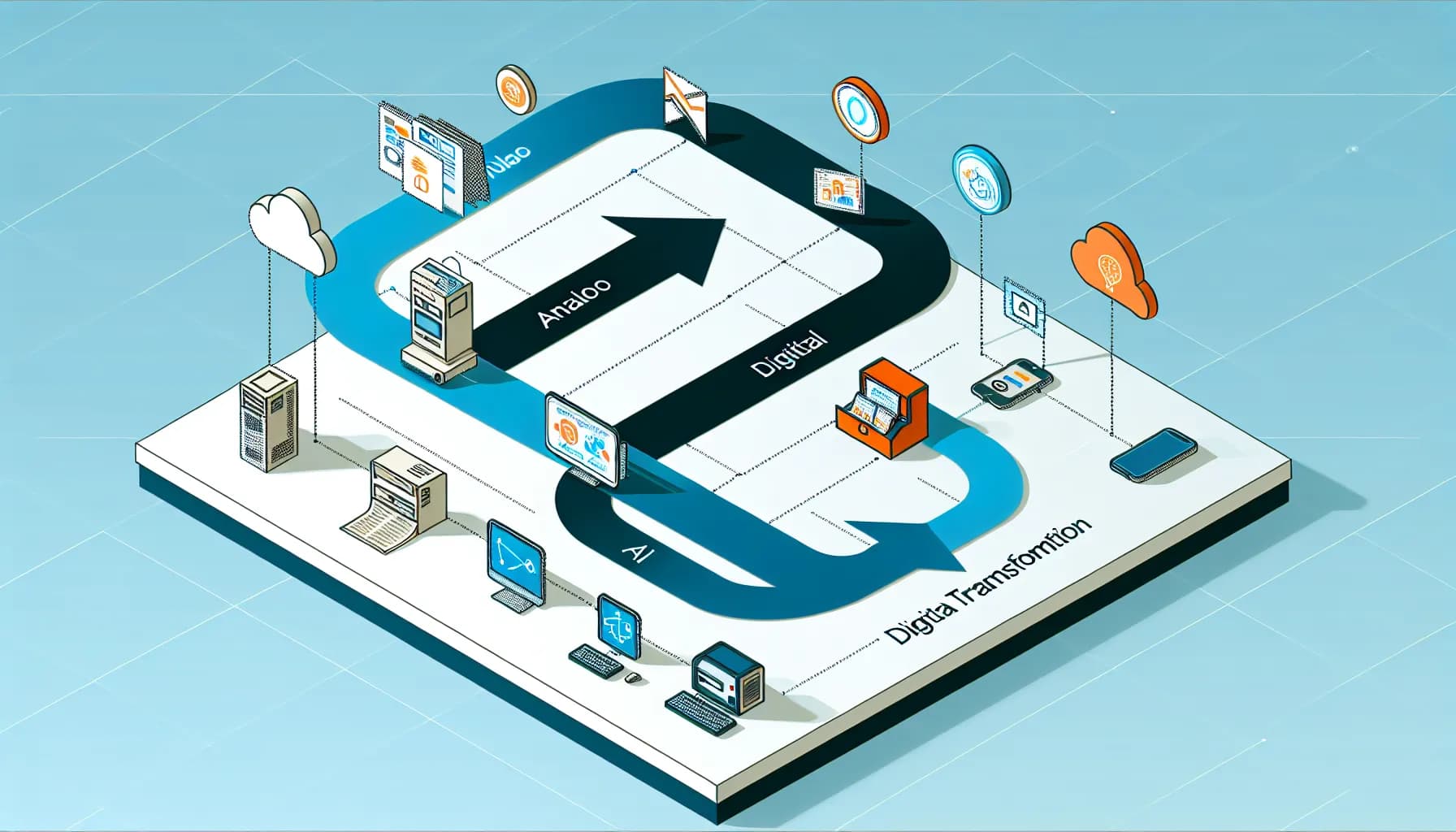
The German Chamber of Industry and Commerce (DIHK) survey from early 2026, covering approximately 5,000 companies, delivers sobering numbers: 42% of small businesses and 20% of mid-sized companies fail to reach even a basic level of digital intensity. At the same time, the study shows that companies making strategic digital investments spend on average 54,000 euros more than the industry average -- and achieve 66% higher returns for it.
The gap between digital leaders and laggards is widening every year. But the starting position is not hopeless: with the right roadmap, any mid-sized company can systematically improve its digital maturity. This article shows how.
Where Does the Mittelstand Actually Stand?#
Before a roadmap makes sense, we need an honest assessment. The DIHK study identifies four maturity levels:
Level 1: Digitally Absent (18% of SMEs)#
- No website or only an outdated business-card page
- Communication primarily via phone and fax
- No digital business processes
- Customer acquisition exclusively through referrals and local presence
Level 2: Digitally Basic (24% of SMEs)#
- Simple website exists but is not mobile-optimized
- Email as the main communication channel
- Individual tools (accounting software, Excel spreadsheets)
- No integration between systems
Level 3: Digitally Active (35% of SMEs)#
- Professional website with SEO fundamentals
- CRM system in use
- Partially automated processes
- Social media presence but without strategy
Level 4: Digital Leader (23% of SMEs)#
- Data-driven decision making
- Integrated systems (CRM, ERP, marketing automation)
- AI-supported processes
- Digital business models
The crucial insight: The jump from Level 2 to Level 3 delivers the highest ROI. This is where the quick wins lie, achievable with a manageable budget.
Digital Maturity Assessment: Determining Your Position#
Before you invest, you need to know where you stand. Conduct an honest self-assessment across these five dimensions:
1. Online Presence#
- Do you have a modern, mobile-optimized website?
- Is it visible in search results for relevant terms?
- Can customers contact you, book appointments, or purchase online?
2. Business Processes#
- How many manual steps does your most frequent business process have?
- Are there media breaks (e.g., receiving orders by email, transferring to Excel, manually entering into accounting)?
- Can employees access company data remotely?
3. Customer Relationships#
- Do you know which customers have the highest lifetime value?
- Can you respond to customer inquiries within two hours?
- Do you use data to predict customer needs?
4. Data Strategy#
- Do you systematically collect and analyze business data?
- Do you make decisions based on data or gut feeling?
- Is your data in one system or distributed across many isolated solutions?
5. Employees and Culture#
- Are your employees trained in using digital tools?
- Is there a person or role responsible for digitalization?
- Are digital improvement suggestions actively solicited and implemented?
Quick Wins: Immediately Actionable Measures#
Not every digitalization measure requires a major project. These three quick wins deliver measurable results within four weeks:
Quick Win 1: Professional Website#
A professional website is the most important digital touchpoint. It works 24/7, reaches every potential customer, and is the foundation for all further measures. What a project like this costs depends on its scope; our packages are on the web design pricing page.
Minimum requirements in 2026:
- Mobile-first design (60%+ of traffic comes from smartphones)
- Core Web Vitals in the green zone (LCP < 2.5s, INP < 200ms, CLS < 0.1)
- SSL encryption and GDPR compliance
- Contact options on every page
- Basic SEO optimization (title, description, schema markup)
Quick Win 2: Implement a CRM System (Budget: 50-150 euros/month)#
A CRM system ends the chaos of sticky notes, Excel spreadsheets, and email folders. Recommendations for mid-sized companies:
- HubSpot Free: For getting started, free up to 1,000 contacts
- Pipedrive: From 14 euros/month, particularly good for sales teams
- Brevo (formerly Sendinblue): Combination of CRM and email marketing
Immediate effect: No customer contact is lost. Every inquiry is captured, assigned, and followed up.
Quick Win 3: Basic Automation (Budget: 20-100 euros/month)#
Automate recurring tasks that cost time every day:
- Appointment booking: Calendly or Cal.com instead of back-and-forth emails
- Invoicing: Automated tools instead of manual PDF creation
- Social media: Buffer or Hootsuite for scheduled posts
- Email responses: Auto-responders for frequent inquiries
Calculation example: If you save 30 minutes daily through automation, that is 10 hours per month. At an internal hourly rate of 60 euros, that equals 600 euros in monthly savings.
12-Month Roadmap: From Basic to Active#
For companies at Level 1-2, here is a realistic roadmap:
Quarter 1: Digital Foundations (Months 1-3)#
- Month 1: Start website relaunch or optimization
- Month 2: Implement CRM system, import existing contacts
- Month 3: Optimize Google Business Profile, first SEO measures
Budget: 8,000-20,000 euros (one-time) + 200-400 euros/month (ongoing)
Quarter 2: Digitize Processes (Months 4-6)#
- Month 4: Analyze and digitize the most important business process (e.g., quote-to-order)
- Month 5: Introduce cloud storage and digital collaboration (Microsoft 365 or Google Workspace)
- Month 6: Digitize accounting (compliance-ready)
Budget: 3,000-8,000 euros (setup) + 100-300 euros/month
Quarter 3: Marketing Automation (Months 7-9)#
- Month 7: Set up email marketing (newsletter, automated sequences)
- Month 8: Start content strategy (blog, LinkedIn)
- Month 9: First advertising campaign (Google Ads or LinkedIn Ads)
Budget: 2,000-5,000 euros (setup) + 500-2,000 euros/month (including ad spend)
Quarter 4: Optimization and Scaling (Months 10-12)#
- Month 10: Analyze results, evaluate KPIs
- Month 11: Scale successful measures, discontinue ineffective ones
- Month 12: Plan strategy for year 2, evaluate AI integration
Budget: 1,000-3,000 euros (analysis and planning)
Total investment Year 1: approximately 20,000-45,000 euros (including ongoing costs)
Government Funding: Using Available Programs#
Germany's federal and state governments support SME digitalization with various programs:
Mittelstand-Digital Centers#
- What: Free consulting, workshops, and demonstration centers
- For whom: SMEs with up to 499 employees
- Particularly useful for: Companies that do not yet know where to start
go-digital (Federal Ministry of Economics)#
- What: Funding for consulting and implementation services
- Amount: Up to 50% of costs, maximum 16,500 euros
- For whom: SMEs with fewer than 100 employees
- Areas: Digital business processes, IT security, digital market development
Digital Bonus (State-Specific)#
Various German states offer additional digitalization funding ranging from 10,000 to 50,000 euros, depending on the state and program.
Tip: Apply for funding BEFORE starting the project. Most programs do not fund measures that have already begun.
The 5 Most Common Digitalization Mistakes#
From our experience with dozens of mid-sized companies, digitalization projects usually fail for the same reasons:
1. Thinking Too Big, Starting Too Small#
Many companies want everything at once: new ERP, new CRM, new website, AI integration. This overwhelms budgets, employees, and organizations. Better: start small, achieve quick wins, then scale.
2. Putting Technology Before Strategy#
"We need AI" is not a strategy. First define the business problem, then choose the right technology. Sometimes a simple Excel automation is better than an AI solution.
3. Not Bringing Employees Along#
The best software is useless if nobody uses it. Invest at least 20% of the project budget in training and change management.
4. Not Defining Clear KPIs#
"We want to become more digital" is not a measurable goal. Define concrete metrics: response time to customer inquiries, website conversion rate, time saved per process.
5. Isolated Solutions Instead of Integration#
Ten different tools that do not communicate with each other create more problems than they solve. When selecting tools, pay attention to API interfaces and integration capabilities.
Conclusion: Digitalization as Competitive Advantage#
The DIHK numbers speak clearly: companies that invest strategically in digitalization achieve significantly higher returns. The gap between digital leaders and laggards grows with every year.
The good news: entry has never been easier or cheaper than today. Cloud-based tools, funding programs, and specialized service providers make digitalization accessible even for small businesses.
The three most important steps for your start:
- Honest assessment: Where do you stand on the digitalization scale?
- Identify quick wins: Which measure delivers the fastest return?
- Apply for funding: Use available programs before you start
Digitalization is not a project with an end date but an ongoing process. But every process begins with the first step. And the best time for that step is now.
