Facts as the foundation
Our web design packages are stored in a central facts source. The public service endpoint reads those details. An agent gets the published package data directly, without having to piece it together from a designed page.
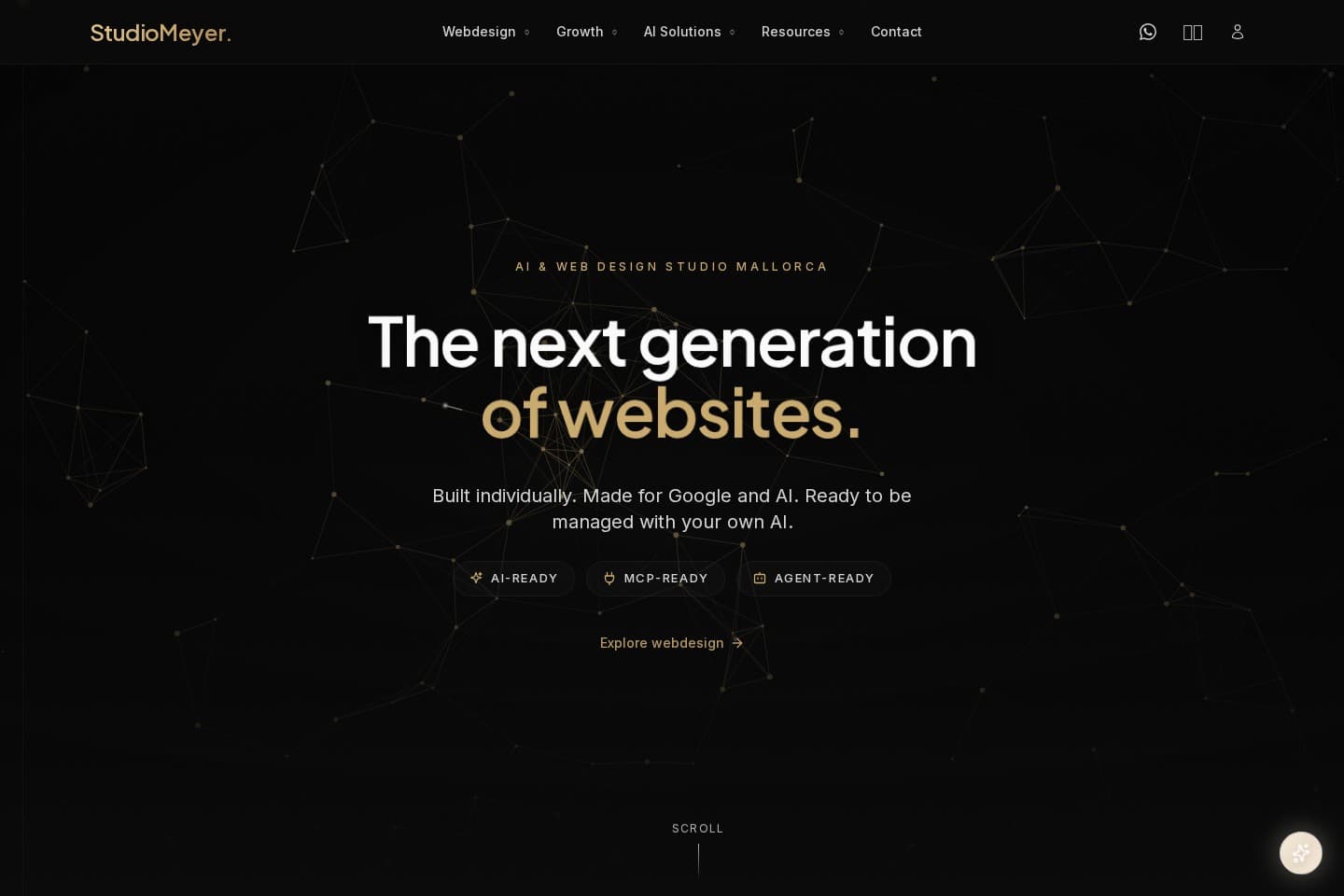
Premium Web Design · Custom Code · AI-Ready · MCP-Ready
Built individually. Fast, machine-readable and ready to work with your own AI. No site builders. No WordPress. No closed system.
People can get to know our studio, explore our services and get in touch.
Company facts, page content and key links are also available in machine-readable formats.
Our public tool directory points agents to the service endpoint. Through this public read access, an agent receives our offer in a structured format: package names, published prices, payment options and StudioMeyer Care.
100%
Custom
100/100
Lighthouse SEO audit
3
Languages
AI + MCP
Ready
Our website shows what AI-ready means in practice: clear pages, machine-readable content and a public interface that lets AI agents retrieve our services as structured data.
Our web design packages are stored in a central facts source. The public service endpoint reads those details. An agent gets the published package data directly, without having to piece it together from a designed page.
Our pages include their content in the initial response. Crawl rules allow search engines to access public pages, while the sitemap lists pages and language versions. Structured information describes our studio and services. Markdown provides page content as plain text, and llms.txt points to key content.
An agent finds the request in the tool directory and can retrieve our offer directly. The response includes our web design packages with published prices, payment options and details of ongoing care.
The website also includes documented design rules, structure and project knowledge. MCP-ready means the technical foundation for controlled AI access is prepared. The functions to be connected form part of the agreed project scope. Changes can be prepared and reviewed before they go live.
What we build
Company site, property portal, restaurant, hotel or digital product: every website is developed individually for the business.
But the difference isn't only in the design.
From the start we build a technical foundation that people, search engines and AI systems can use, and that keeps growing later.
Professional company sites that build trust and explain your services clearly. Fast, multilingual and structured so Google and AI systems can read your services and details clearly.
Sell products or services straight from your own website, with a secure checkout and without a heavy shop system if you don't need one.
Real estate, restaurants, hotels, medical practices and other businesses have their own data and workflows. So we don't just adapt the design to the industry. We build the website around the actual business.
How it works
Our process doesn't end when a website looks good and goes online.
At the same time we build the technical foundation for it to be found, understood and safely developed further later on.
We talk about your business, your services, your audiences and your goals. From that come the structure, the features and the basis for the information and rules your website will need to know later.
We develop an individual design and the user journey of your website. You can review the result before development is finished.
The website is developed individually. Alongside it we build the technical structure for Google and AI systems and store the project's context: layout, components, design rules and key requirements.
The website goes live with hosting, SSL, backups and monitoring. At the same time it is ready to work with your own AI in a controlled way and to be extended later.
Pricing
Foundation
Fixed price · or twelve monthly instalments
When you want a professional website that isn't technically outdated on launch day.
Growth package · Recommended
Fixed price · or twelve monthly instalments
When your website should also build content and visibility over time.
Individual
Binding fixed price after the briefing
When the website becomes part of how you run your business.
Every package includes the first twelve months of StudioMeyer Care: hosting, security, backups and technical updates. After that Care costs 149 € a month and is cancellable monthly.
Foundation and the Growth package have fixed prices. Individual projects start at 6,500 €: after the first call we agree the scope together, and you get a binding fixed price. No open-ended hourly billing, no surprises. Every project can be paid in twelve monthly instalments at no extra cost if you prefer. Once paid in full, the website is yours, including code, design and content. All figures are final prices. No VAT is added. There is no fixed upper limit on the number of pages, the agreed scope is written into the quote.
Available separately for Foundation and the Growth package: connections to CRM, calendar and company data. In Individual they are included within the agreed scope and priced in your quote. A memory for your AI can be added separately to any package.
Hosting your way
EU as the default. Other regions on request. We deploy where it fits your business, your customers and your requirements.
Pick a region, we'll show you where we host:
Hetzner Germany
Default. GDPR-native, servers in Germany. Same place our own SaaS products run.
Our own SaaS products (Memory, CRM, GEO, Crew) stay on EU servers for architecture reasons. Region choice applies to your custom hosting: website, n8n workflows, custom MCP servers, managed AI server.
What a website from us includes
A modern website should do more today than look good and work on a smartphone.
That's why we build the important foundations in from the start, instead of retrofitting them one by one later.
No site builder and no ready-made template. Your website is made individually for your business. That keeps us independent of themes and plugin systems and lets us control the technical foundation ourselves.
Your website is structured so that not only classic search engines but also modern AI systems can grasp content, services and connections as clearly as possible.
Your website is prepared to provide controlled access for your own AI. That lets an assistant do more than read the public site: it can work with functions set up for that purpose.
Design, structure, components and key project rules are part of the website system. An AI that works on the website later doesn't have to figure out from scratch every time how everything is built.
AI doesn't simply get unrestricted access to a live website. Changes can be prepared and reviewed first, before they are published.
We leave out unnecessary layers, themes and plugin bundles. That keeps the website lean and the loading times short.
German, English and Spanish each get their own URLs and a technically clean structure for search engines and AI systems.
Opening hours, address, services and other key information are marked up in a structured way, instead of only sitting somewhere in the page text.
Answers questions about your services, prices and opening hours, around the clock, even while you are at work. Included in every package.
One email: how many people came, where they came from, what changed. No login, no wall of numbers. Included in every package.
SSL, backups, technical updates and monitoring run through StudioMeyer Care. If something technical isn't right, we take care of it.
Semantic structure, contrast, keyboard operation and screen-reader support are part of the build from the start.
The SEO foundation is part of every website. If you want ongoing work on visibility and inquiries after that, you will find it under Growth: SEO service, local SEO, Google Ads and ChatGPT Ads.
See GrowthDemo websites
More on the package
References
FAQ
Foundation costs 2,500 € and the Growth package 3,500 €, both at a fixed price. Individual projects start at 6,500 € and get a binding fixed price after the briefing. You pay once or in twelve monthly instalments at no extra cost; once paid in full, the website is yours, with code, design and content. The first twelve months of StudioMeyer Care are included, after that Care costs 149 € a month and is cancellable monthly. We agree the scope in the first call and put it in writing in the quote; there is no fixed upper limit on the number of pages. All prices are final. No VAT is added.
We don't build on a ready-made website system. The website is developed individually and, at the same time, structured so search engines and AI systems can work with it. On top of that comes its own project context and the option to connect the website to your own AI in a controlled way. So you don't just get a different interface, you get a different technical foundation.
Foundation takes 1 to 2 weeks, the Growth package 2 to 3 weeks, Individual from about 4 weeks. If you already have copy and images, it's faster. If we write content or run a photo session, add a week. After the first call we give you an honest estimate.
Yes. We carry over existing content, plan redirects for old URLs and make sure you don't lose visibility you already have. Every existing address gets a redirect to its new target, so neither Google nor your visitors run into a dead end. Pricing follows the same packages as a new website.
That's what StudioMeyer Care is for. It covers hosting, SSL, backups, monitoring, security, technical updates, bug fixes, smaller changes, health checks and a person you can call. You don't have to deal with any of it yourself. The first twelve months are part of the fixed price, after that Care costs 149 € a month and is cancellable monthly.
Yes, and this is exactly where our approach differs from a classic CMS. You don't have to click through a backend. The website can be set up so you prepare changes in a conversation with your own AI. We can of course still make changes for you.
Your website is built so an AI assistant can access functions set up for that purpose, in a controlled way. You can then describe a change instead of working out which menu or file it has to be made in. What the AI is allowed to do is limited technically. And you are not tied to one particular provider.
That isn't our goal. We build the process so changes can be prepared and reviewed in a controlled way. The AI should take work off your hands, not publish changes unchecked.
Really. Every website gets what AI assistants like ChatGPT read: clean, well-structured code, precise details about your business in a form machines understand, a short plain-text overview of the site, a business card for AI agents and access for the AI providers' crawlers. That is exactly how our own site became a source AI assistants quote. How we measure it is laid out on our AI visibility page.
Once paid in full, the website is yours with code, design and content. You are not tied to a site builder or a proprietary theme. After the first twelve months, StudioMeyer Care costs 149 € a month. Cancel Care and you get the source code as a Git repository. After Care ends, your website keeps running for fourteen more days, so you can move to any provider without time pressure. We keep your website data for six months after cancellation, and you can request an export during that time.
Yes. CRM, calendar, booking systems, internal data, your own MCP tools, automations or agents can be added later. We plan the technical foundation for that into the build.
Industries
Hotel, restaurant, real estate, medical practice, architecture or yacht brokerage: every industry has its own data, content and workflows. So we don't just build a different design, we build the right technical structure behind it.
If you're building now, you shouldn't build yesterday's website. We develop a website that works fast and professionally today and is ready for how people and AI systems will use the web tomorrow.
Book your free call nowFurther reading
Interactive 3D elements, optimization and Gaussian Splatting, with performance budgets and accessible alternatives.
German, English, Spanish, French, Catalan. What a five-language website actually demands, and why the QR code on the business card was the hardest part.
Instead of a new interface we connected the existing assistant application of a rental office to memory, contacts and the inbox.