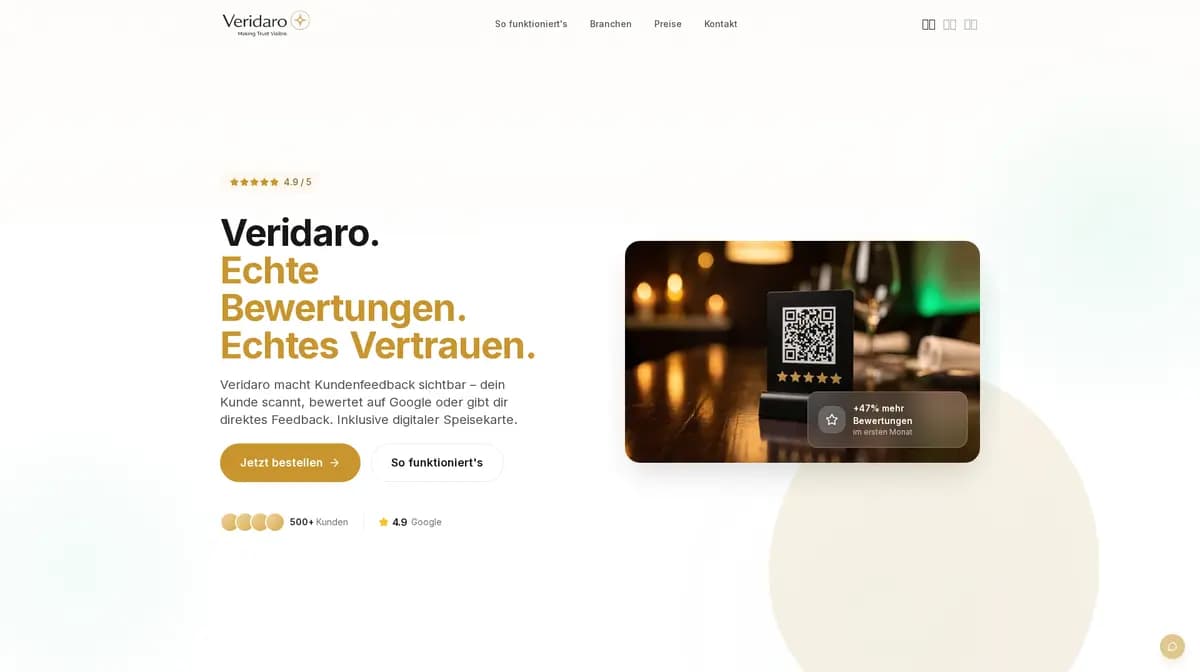
There is a difference between a website that advertises a product and a product. The difference sits at the point where somebody buys.
On a website the job ends at the click on "buy now". In a product it starts there. Somebody has paid, and from that moment they expect something to happen: access, an account, an interface they can work in. If that does not happen automatically, a human has to do it by hand. And at that moment it is no longer a product but a service with a price tag on it.
For Veridaro we built the whole thing, from the front page into the interior.
The Five Minutes After Payment#
From the outside the flow looks unspectacular. Somebody picks a plan, lands in checkout, enters their details, confirms. And then they are in.
Quite a bit happens in between. The payment provider reports the successful transaction back. The system then creates an account, assigns the right plan, unlocks the matching features and sends out access. No human is involved, not at night and not on a Sunday.
Login runs on a magic link. You enter your email address, get a link, click it, you are signed in. No password to be set, forgotten and reset. For a tool somebody opens every few weeks that is the better route, because otherwise the forgotten password is the most common reason people stop using a product.
The Interior Is The Product#
What comes after the login is the part nobody sells on a screenshot, and the part that decides whether somebody stays.
There is an analytics view showing what actually happens. A QR generator, because the product works in a physical place and the bridge to it is a code on paper. A PDF export for everything that gets printed or handed on. An editor for digital menus. A mailing system with tracking, so it is visible whether messages arrive and get read.
Every one of these features is an answer to a "could you just". Could you just make a new QR code. Could you just change the menu. Could you just check how many there were. Every one of those is a design fault inside a product, because it multiplies with the number of customers.
Referrals Are A Feature, Not An Accident#
On top of that comes a partner programme. Whoever recommends the product gets a share, and the whole thing settles itself.
That is a decision you make at the beginning or not at all. Adding a partner programme afterwards means having to attribute every past payment to a source, and that attribution no longer exists by then. Build it in from the start and it is one additional identifier travelling along from the ad to the invoice.
Three Languages In A Product Is Not Three Languages On A Site#
On a website multilingual means the same content in three versions. In a product it also means every automated message needs three versions. The welcome mail. The invoice. The magic link. The reminder. The error message when something did not work.
Those texts are invisible while everything runs, and visible exactly when somebody is annoyed already. An error message in German inside an otherwise Spanish interface is the moment a product starts to feel cheap.
What Goes For Numbers On A Sales Page#
One point that has nothing to do with technology and still belongs here.
Sales pages like to carry numbers. Ratings, customer counts, averages. They work, which is why they are there. The catch is that a number without a source is no longer read only by humans but by language models too, and those pass it on as fact. What starts as a nice detail on a page is, two months later, a claim showing up inside an AI answer that nobody can back.
Our rule has become simple: a number only goes on a page if it says where it comes from and what it refers to. If that makes the sentence clumsy, the clumsy sentence is the right one.
The Sentence That Stays#
Building a product means doing every manual step in advance. The visible part is the front page, the valuable part is everything after it.
Anyone planning a software product who has to cut the budget almost always cuts the interior, because nobody sees it while selling. That is the one place where cutting gets most expensive later.
