Large websites forgive a lot. If one section is weak it disappears between the others. A small site has no between. Every section is one out of five, and a weak one is obvious immediately.
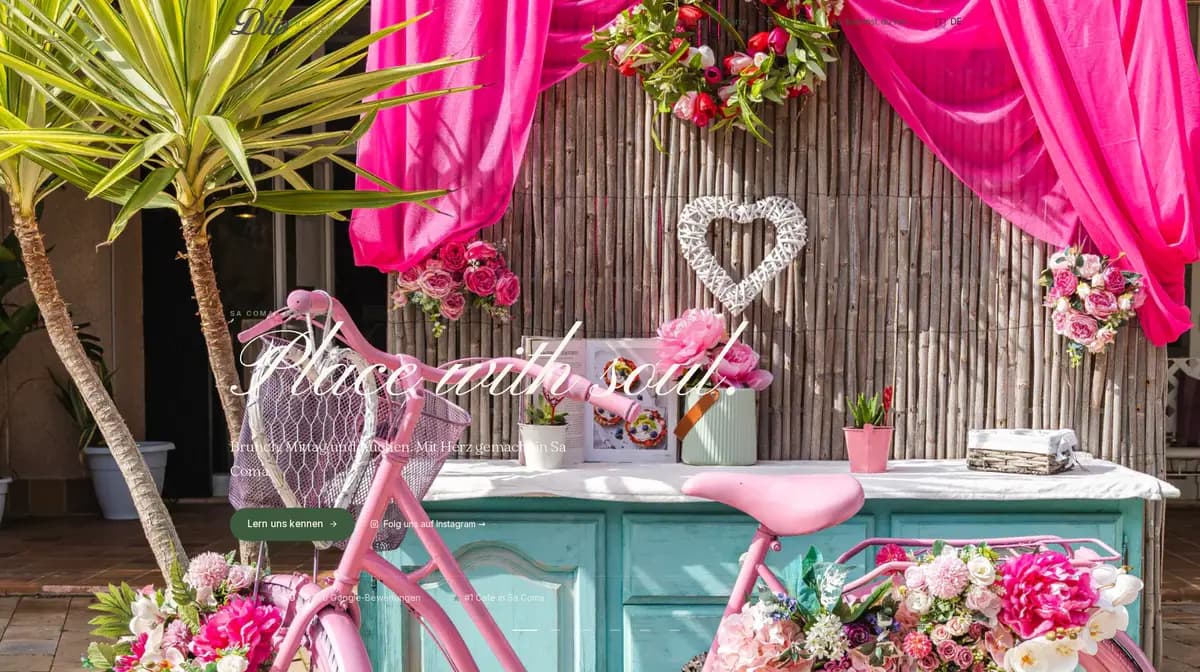
For Dito in Sa Coma we built one of those small sites. A cafeteria, breakfast, a place with regulars. The site has no booking system, no shop, no customer account. It has four questions to answer, and if it fails one of them it has failed.
The Four Questions#
Whoever opens a cafe's website wants to know: what does it look like, what is there to eat, where is it, when is it open.
That is it. Everything else is trimming.
So that is how the site is built. A photo gallery, because for a place to eat the picture is half the decision. The daily menu. A section with directions and opening hours that appears exactly when you need it instead of vanishing into the footer.
What was left out is the actual work. No newsletter popup. No story about the philosophy of the house. No rating tiles pulled from other sources. On a small site every additional element costs something, because it pushes the four answers further down.
Opening Hours Are Not Text#
A detail you find done wrong on almost every restaurant website: opening hours sit there as running text. "Daily from 8 to 15, closed Mondays." For humans that is enough. For machines it is not.
Anyone searching for breakfast nearby on their phone today gets the answer from a map, from a search engine or from a language model. All three read structured data, not prose. If the hours only exist as a sentence, the machine does not know whether the place is open right now and leaves it out of the answer.
So opening hours, address and type of business also sit on this page as structured data in the source. The visitor sees none of it. The machine sees all of it.
Three Languages, With No Half Measure#
Sa Coma lives on tourism, and on German, British and Spanish tourism in equal measure. The site exists in German, English and Spanish, plus the Spanish legal texts that are mandatory for a site with a Spanish operator.
The usual mistake here is the half translation: menu and front page in three languages, the rest left in one. That does not bite immediately, it bites on sharing. Somebody sends a friend the link to the menu, the friend lands in a language they do not read, and closes it.
Built For The Second Location Before It Existed#
The most interesting decision in this project concerns something that does not exist yet.
The site is structured so a second location can be added cleanly. Not as a second website, not as a subpage standing next to the first, but as another entry in a structure that assumes more than one place from the start.
That costs a bit of thinking on the first build and saves a complete rebuild later. Anyone building a site for exactly one venue who opens a second one two years later faces a choice between a second site maintained twice and a rebuild that costs more than the original.
You cannot anticipate every future. But for a venue that is doing well, a second location is not an exotic guess, it is the most likely next step.
What I Do Differently On Small Sites#
On a large site the question is what goes in. On a small one it is what goes out.
That is the more uncomfortable question, because every element that goes out belongs to somebody who asked for it. It is still the right one. A site where every section answers something works better than one you have to search through.
