When a website is meant to get five languages, most people think about the translation first. That is the easy part. Translation can be commissioned.
The hard part is everything else. Five languages mean five addresses for every page, five sitemap entries, five versions of every automated email and the question of what happens when a piece of content is missing in one language. They also mean each of those five versions has to tell search engines that the other four exist. Without that, five pages with nearly identical content compete against each other, and Google decides on its own which one to show.
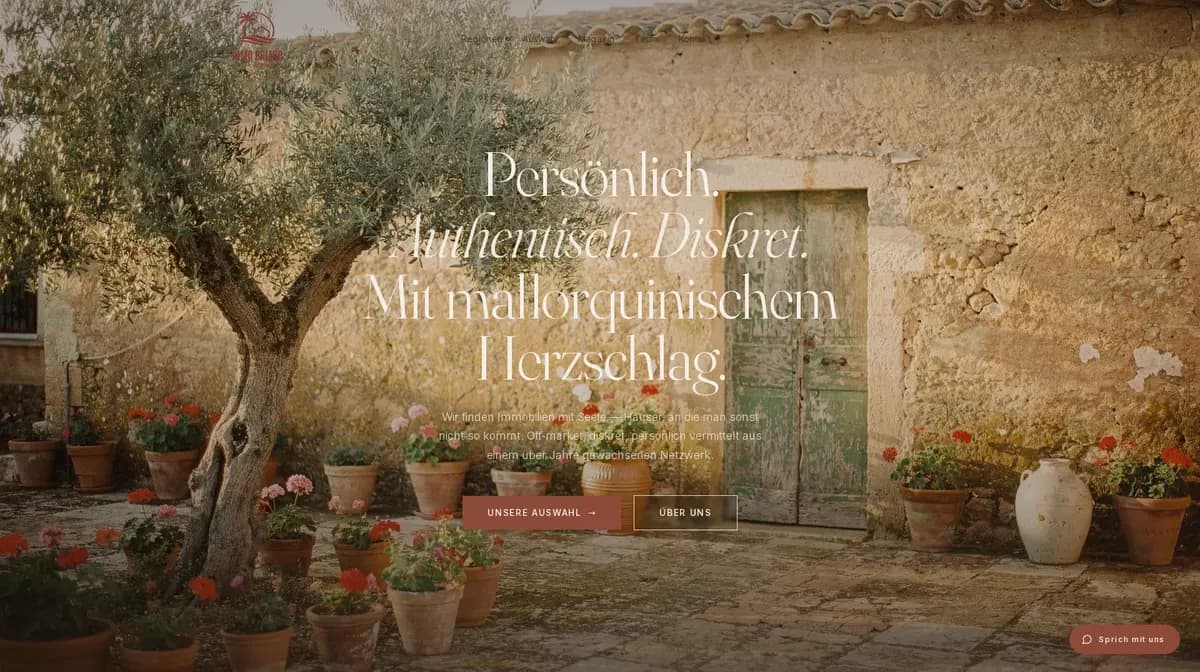
For Alma Balear we built a site in German, English, Spanish, French and Catalan. A real estate office for rural Mallorca, with two offices on the island.
Addresses In The Local Language#
A decision that is easy to overlook: what are the subpages called in each language?
The convenient route is to use the same English words everywhere and just put a language code in front. The better route is to translate the address as well. On the Spanish version the team area is then actually called what a Spanish visitor would call it, on the French version accordingly.
That is not a detail for purists. Words in the address are a signal, and one of the few a search engine can read without interpretation. Someone searching in French for a real estate office finds a French address faster than an English one with French text behind it.
The QR Code That Saves Itself As A Contact#
The part of this project that carried the most work is one you cannot see.
The team area of the site comes with QR codes, one per person. Scanning one does not show you a website, it offers to save the contact straight into your phone. Name, role, phone number, email address, company. One tap, done.
That sounds like a standard function and is a trap. The format for digital business cards exists in several versions, and Android and iPhone handle them differently. Take the newest version and it works on one device while the other receives a file nobody can do anything with. So we deliberately went with the older, more widely supported version. Less elegant, works everywhere.
There is a second safeguard on top. These codes end up on printed material. Paper cannot be updated. A code pointing at an address that will not exist in two years is a printed dead end. So behind the codes sits a switch that still delivers something sensible even when the structure of the site changes.
A Magazine On A Company Site#
The site has a magazine layer of its own with full article pages. For a real estate office that is unusual, and it is the most effective decision in the whole project.
Property listings turn over. A property is sold, the page disappears, the address is dead. Anyone building a website purely out of listings builds on sand: the stock of pages shrinks and grows without anything ever staying put.
An article about a region, about how a purchase works, about the differences between two areas stays. It gets found, it gets linked, it gets read by language models when somebody asks where on Mallorca to look away from the known corners. That is the substance carrying a company site across the years.
On A Site Like This, Images Are The Entire Weight#
A real estate site consists essentially of photos. Editorial gallery, atmosphere, property shots, team, two locations. That is a lot of payload, and payload on a phone is waiting time.
So here the images run through a dedicated cache at the edge of the network. In plain terms: an image is produced once at the right size and afterwards served by a machine that stands closer to the visitor than the original one. Whoever opens the site in Palma and whoever opens it in Cologne both get an image from next door.
On a site with five pictures the difference is not measurable. On a site that lives off pictures it is the difference between "runs" and "stutters".
What Five Languages Cost If You Take Them Seriously#
Honestly: five languages cost more than three, and not linearly. Every new piece of content, every new page, every change to a legal text multiplies.
The way out is to hard-wire as little as possible. The team details live in one place and are used jointly by the front page, the team area, the QR pages and the digital business cards. Change a role and it changes everywhere. Typed out four times, three of those places would be wrong from the first change onward.
That is the real lesson from a multilingual project: the languages are not the problem, every piece of information that exists more than once is.
