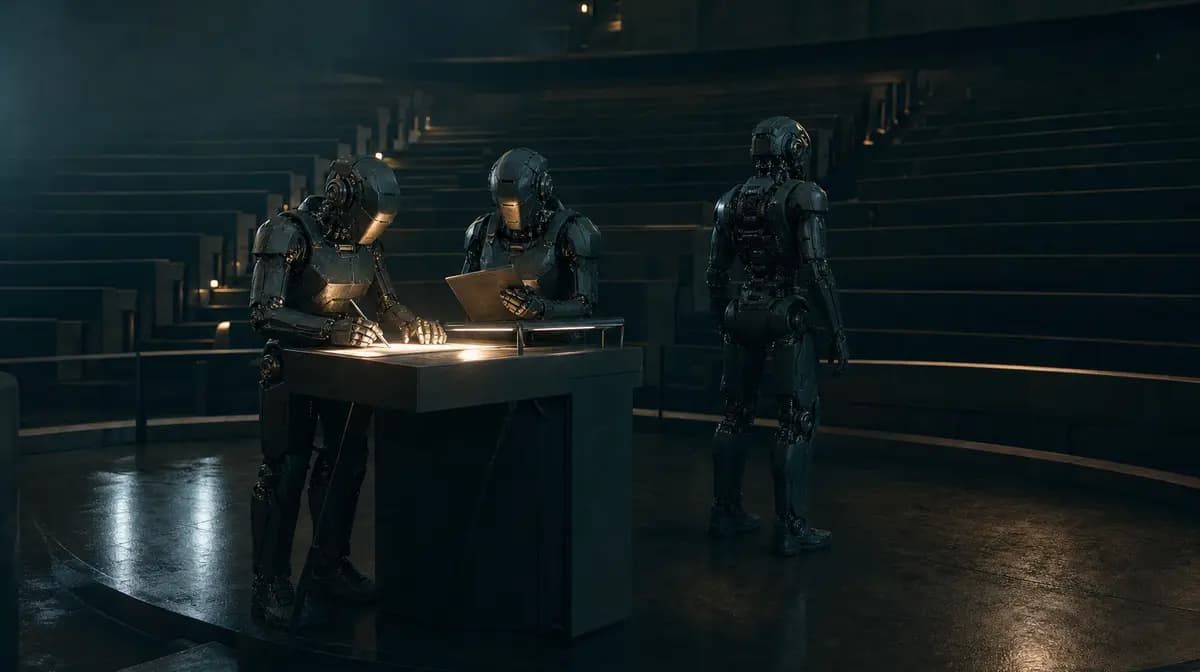
The most interesting part of our learning platform is not the content. It is the question of who makes it.
The Academy is a site with lessons, recipes and guides for building your own AI systems, in six levels from the entry point to your own MCP server. It has no editorial team in the usual sense. It has a group of agents, each with a role.
The Roles#
There is one that researches what is moving out there. One that turns that into topic proposals. One that writes. One that reviews what was written and is allowed to reject it. One that watches the numbers, meaning what gets read and what sits idle. And one that checks whether the site appears in AI answers at all.
That division is the actual trick. An agent reviewing its own text finds nothing. It just decided the text was good, otherwise it would have written it differently. Self-review works about as well with language models as with humans.
Separating Makes The Difference#
As soon as writing and reviewing are two different agents with two different assignments, something happens.
The reviewer has no reason to defend the text. Its assignment is to find weak spots, and it finds them. Not because it is smarter, but because it is looking from somewhere else.
That same pattern now sits underneath almost everything we build with agents. One agent that builds and a second that refutes. Where the second is explicitly told to find something, not to "have a look".
What Stays With The Human Anyway#
Three things.
The structure of the whole. Which six levels exist and what belongs in which is a didactic decision. An agent can propose gaps, but the build of a course is an opinion about how people learn.
The release. No text goes live without a human. That is not a question of quality but of liability: what stands on a page is the operator's responsibility, not the model's.
And the tone. A model writes correctly and interchangeably. The difference between an explanation that lands and one that is accurate is still handmade.
Why The Topic Agent Is Tied To The Structure#
An agent proposing topics while only looking at what is currently in season produces pieces about whatever is currently in season. That is not a course, that is a news ticker.
So it hangs off the course structure rather than the news cycle. It proposes what is missing at a given level, not what is being searched for a lot. Fewer proposals, and usable ones.
What It Is Good For#
The Academy sells nothing. It is free and needs no account.
The reason we run it anyway is twofold. First, it is the best rehearsal we have: whatever we claim about memory-first working and agent patterns has to stand there in a form somebody without our backstory understands. Anyone who cannot explain something has not understood it.
Second, it is the evidence. A learning platform run by exactly the kind of system it explains is a different kind of proof than a reference list.
When the operation slips, you see it there first. That is uncomfortable and precisely the point.
